Breaking News
God-Shiv Temple Controversy JDA’s notice to “Bhagwan Shiv” at Vaishali Nagar reveals deep legal and civic turmoil —
Jaipur, Nov.27,2025:On 21 November 2025, JDA pasted an eviction notice on the boundary wall of a Shiva temple located on Gandhi Path, Vaishali Nagar-
- The notice was addressed to Bhagwan Shiv — not to any temple trust or managing committee.
- It demanded a response within 7 days. The notice gave a date of 28 November 2025 for the temple to present documents proving legitimacy.
- The reason cited: under a plan to widen Gandhi Path to 100 feet (as per High Court petition no. 658/2024), the temple’s boundary wall allegedly intrudes 1.59 meters into the road-alignment.
To many, this sounded like a Kafkaesque error — how can a sacred shrine receive a legal notice addressed directly to a deity
What Exactly Did JDA Claim
According to JDA’s “PT survey report (Zone-7),” the temple’s boundary wall falls inside the demarcated line for Gandhi Path. The 1.59 meter “encroachment” forms the sole basis for the notice.
JDA officials argue their hands are tied: under legal mandate and enforcement orders (likely guided by a recent directive from the Rajasthan High Court), any unauthorized structure within the road-expansion corridor must be issued a notice — regardless of religious or historical significance. The same drive has targeted dozens of houses, shops, and informal encroachments across Vaishali Nagar and other areas.
That said, JDA reportedly did not address the notice to any temple trust, committee, or managing body, nor did it mention the temple’s history or heritage status. This cold-text, “paper-only” approach has triggered widespread criticism.
Outrage, Confusion, Fear
The reaction among locals has been swift and intense.
- Many residents and devotees say the temple is decades — if not centuries — old, built with the support of local community and earlier JDA-linked efforts. They argue that labelling it as “illegal encroachment” is absurd and insensitive.
- Some feel their religious sentiments have been insulted: issuing a notice directly to a deity is almost sacrilegious in popular understanding. “Notice to God?” — the question echoes among social media posts.
- The broader public, even those not directly connected to the temple, fear a precedent: if a religious site can be served eviction, could historic, heritage-bearing or community spaces be next
At least 70 other houses and shops along Gandhi Path already got eviction notices on 21 November, which adds to the sense of mass uprooting.
As of now, locals say they plan to protest — possibly outside JDA offices — and some are mobilizing legal support.
Wider Eviction Drive by JDA
The God-Shiv temple case did not arise in isolation. It is part of a broader crackdown by JDA across Jaipur to remove unauthorized constructions and encroachments.
Earlier in November 2025, the JDA began issuing eviction notices in several areas including Loha Mandi, Vaishali Nagar, Queen’s Road and Gandhi Path, especially after a tragic accident on 3 November that claimed 15–16 lives — reportedly linked to congested roads and encroachments.
- The eviction drive is said to be in compliance with a High Court order that emphasises adherence to the city’s master plan (likely Master Plan 2025), which defines mandatory road widths and prohibits unauthorized structures along major roads.
- JDA has previously bulldozed illegal colonies, removed encroachments and reclaimed government land across multiple zones of Jaipur — showing that the persuasion is structural, not personal.
So technically, JDA may argue they are simply following directives and enforcing urban planning norms — but the blunt application in case of a temple invites serious questions about sensitivity, heritage, and civic consent.
Legal, Civic & Social Fallout
Given the gravity of the situation, multiple outcomes are possible.
- Legal challenge: Locals and devotees — perhaps along with temple’s managing body if one exists — may approach the High Court or another competent court, arguing that issuing notice to a deity, ignoring heritage, and failing to treat the temple as a matter of public faith violates constitutional rights.
- Public protest and backlash: Already, social media campaigns using hashtags like #SaveShivMandir and #JDAvsBhagwan are trending in Jaipur. People may gather outside JDA offices or hold peaceful demonstrations demanding that the notice be withdrawn and respect for religious sentiments be restored.
- Policy discussion: This controversy may trigger wider debate on whether civic authorities should treat religious/spiritual structures differently — taking heritage value, faith, community dependence into account rather than mechanical encroachment rules.
- Precedent risk: If JDA proceeds with demolition, it may set a precedent that even longstanding religious structures are vulnerable — leading to anxiety among communities across the city (and perhaps beyond) about the safety of their temples, mosques, churches or shrines.
Why the God-Shiv Temple Controversy Matters to Every Jaipur Citizen
- Urban planning vs sentiment: The case pits civic-planning imperatives (road widening, traffic safety) against faith, heritage, and people’s emotional connection to religious places.
- Rule of law vs compassion: While JDA may be bound by law, the question is: should laws be applied with rigid uniformity or with empathy when long-established religious/spiritual institutions are involved?
- Risk of alienation: If religious sites are not treated sensitively, it risks alienating communities — especially if decisions are seen as disrespectful or insensitive to faith.
- Transparency and procedure: The fact that the notice was not addressed to a temple trust or committee raises serious concerns about procedural fairness and administrative sensitivity.
What Locals & Believers Are Asking
- Who built the temple originally — was it planted by the community, local trust, or under a JDA-supported initiative? If JDA itself participated, how can they now call it encroachment?
- Why was no prior survey or heritage-assessment done before shifting the project plan?
- If the temple’s boundary truly falls on proposed road-line, why was there no attempt to negotiate alternate alignment or re-survey the road plan in heritage zones?
- For villagers and residents who accepted the temple as part of their social fabric for years — is uprooting it justifiable?
To many, the God-Shiv Temple Controversy isn’t just about a wall or encroachment — it’s about respect for faith, memories and identity.
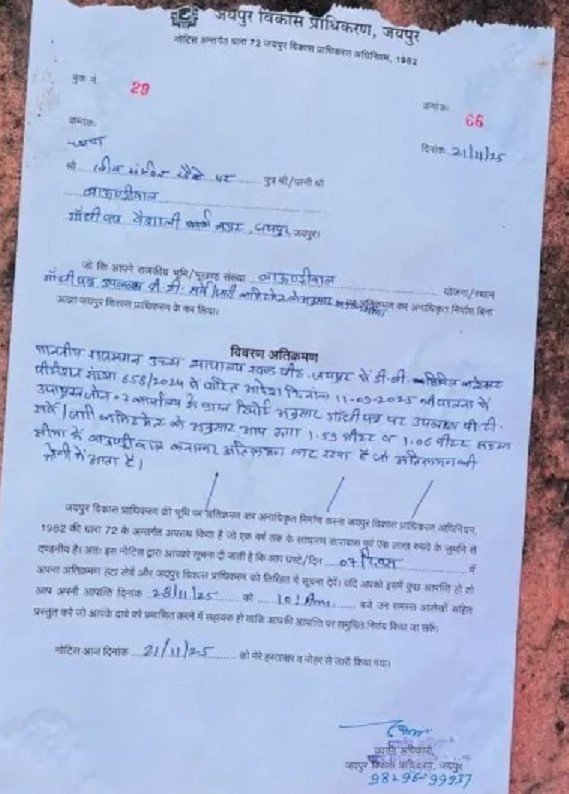

- Read the original report of JDA’s notices and local reaction from the news article “जयपुर में ‘भगवान शिव’ ने किया अवैध कब्जा! JDA ने थमाया नोटिस; कोर्ट में हाजिर होने का दिया आदेश.”
- For background on JDA’s city-wide eviction drive and loop-in with the High Court Master Plan directives.
The God-Shiv Temple Controversy is more than a local dispute; it’s a mirror reflecting how urban development, civic enforcement, heritage and faith intersect — often uneasily. As Jaipur strides toward modernization and orderly civic infrastructure, the challenge remains: can the city uphold legal norms without trampling the delicate tapestry of communal faith and heritage