Breaking News
India-US Trade Deal: Trump Says India Benefited for Decades, Yet a Historic Modi Agreement Could Be Near
India-US Trade Deal remains in focus after Donald Trump said India benefited from high tariffs for decades while expressing confidence in a major agreement with Prime Minister Narendra Modi. Explore tariffs, trade disputes, agriculture concerns, and what the deal could mean for both economies.
5 June, Credent TV | The India-US Trade Deal has once again become one of the most closely watched developments in global commerce after US President Donald Trump made a series of remarks about trade relations between Washington and New Delhi.
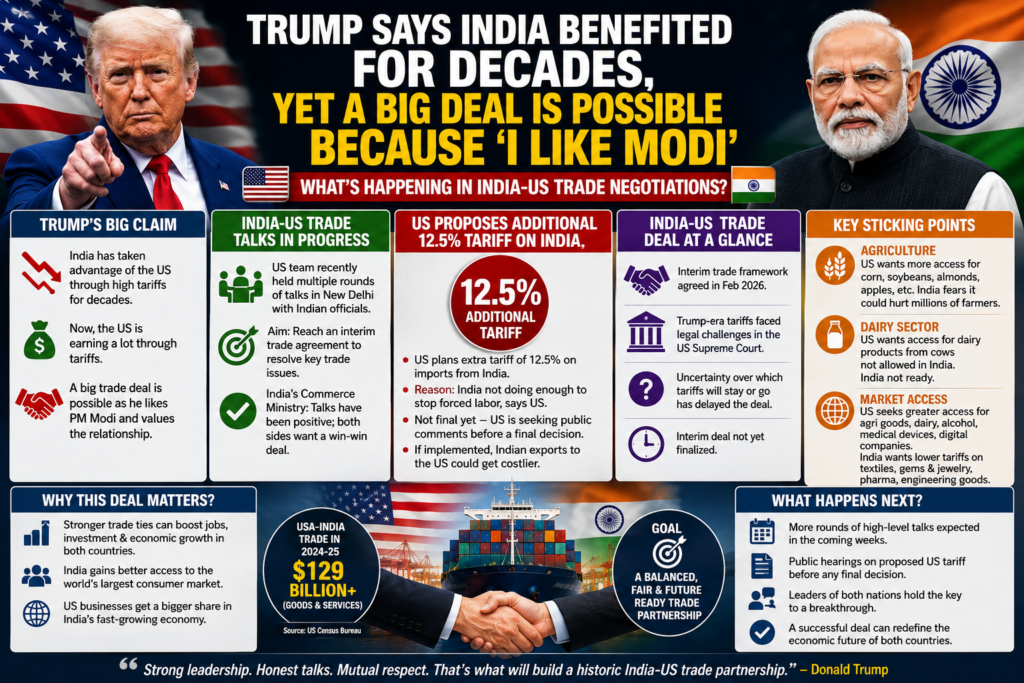
Speaking about bilateral trade, Trump claimed that India had imposed high tariffs on American goods for decades and had benefited significantly from those trade policies. At the same time, he emphasized that the United States is now earning substantial revenue through tariffs and expressed optimism about reaching a major agreement with India in the near future. Trump also highlighted his personal rapport with Prime Minister Narendra Modi, describing him as a good friend and suggesting that strong leadership-level relations could help move negotiations forward.
His comments come at a critical time when officials from both nations are engaged in intensive discussions aimed at advancing the India-US Trade Deal and resolving long-standing trade disputes.
Trump’s Latest Remarks on India-US Trade
The latest debate surrounding the India-US Trade Deal was triggered by Trump’s assertion that India had “taken advantage” of the United States through its tariff policies over many years.
According to Trump, American exporters often faced higher duties while attempting to access the Indian market. He argued that the situation has changed significantly and claimed that the United States is now generating substantial revenue from tariff measures imposed on imports. Despite these criticisms, Trump maintained a positive tone regarding bilateral relations and suggested that a significant trade agreement remains within reach.
His statement reflects a broader strategy that has characterized his trade policy: using tariffs as leverage while simultaneously pursuing negotiations aimed at securing improved market access for American businesses.
Why Trump Says India Benefited from High Tariffs
For years, tariff structures have been one of the most contentious issues between the two countries.
The United States has repeatedly argued that India’s tariff regime has made it difficult for American companies to compete effectively in sectors such as agriculture, medical devices, dairy products, and alcoholic beverages.
India, however, has defended its tariff policies by pointing to the need to protect domestic industries, farmers, and small businesses from overwhelming foreign competition.
Trump’s latest comments are consistent with long-standing American concerns that India’s import duties have historically been higher than those imposed by many developed economies. While trade experts may debate the extent of the advantage, the issue has remained central to every major discussion surrounding the India-US Trade Deal.
India-US Trade Deal Negotiations Gain Momentum
Despite recurring disputes, both governments appear committed to advancing the India-US Trade Deal.
Recent rounds of negotiations in New Delhi have reportedly been constructive, with officials discussing tariff reductions, customs procedures, market access, digital trade, and regulatory cooperation. India’s Commerce Ministry has indicated that discussions have been positive and that both sides are working toward an arrangement that benefits businesses and consumers in both countries.
Commerce Minister Piyush Goyal has also expressed optimism, suggesting that the first phase of the trade agreement could be finalized in the coming weeks if negotiations continue smoothly.
This momentum has raised hopes among exporters, investors, and multinational corporations that the India-US Trade Deal could become a landmark economic partnership.
Proposed 12.5% US Tariff Creates Fresh Challenges
Even as negotiations continue, a significant obstacle has emerged.
The Office of the United States Trade Representative (USTR) has proposed an additional tariff of up to 12.5% on imports from India and several other economies. The proposal stems from a Section 301 investigation related to the enforcement of restrictions on goods allegedly linked to forced labor practices.
If implemented, the proposed tariff could increase costs for Indian exporters and reduce the competitiveness of Indian goods in the American market.
The proposal has not yet become law. The USTR is currently seeking public comments before making a final determination. Hearings are expected before any final decision is announced.
For businesses closely monitoring the India-US Trade Deal, this proposed tariff represents a new layer of uncertainty.
Why the Trade Agreement Has Not Been Finalized Yet
Although both sides have made progress, several developments have complicated efforts to conclude the India-US Trade Deal.
Earlier, an interim trade framework had been discussed as a stepping stone toward a broader agreement. However, legal challenges involving certain Trump-era tariff measures created uncertainty about the future structure of American trade policy. These developments slowed the pace of negotiations and raised questions about how future tariffs would be incorporated into any final agreement.
Trade experts note that while political leaders may support an agreement, technical negotiations involving thousands of products, regulations, and compliance standards often require extensive discussion.

Key Disputes in the India-US Trade Deal
Several important issues continue to divide negotiators.
1. Market Access
The United States wants greater access to the Indian market for:
- Agricultural products
- Dairy products
- Medical devices
- Alcoholic beverages
- Digital services
India, meanwhile, seeks better access for:
- Textiles
- Gems and jewelry
- Pharmaceuticals
- Engineering goods
- Agricultural exports
These competing priorities have made the India-US Trade Deal negotiations particularly complex.
2. Tariff Reductions
India wants the United States to reduce tariffs on several export-oriented sectors.
The United States wants India to lower import barriers that American businesses consider restrictive.
Balancing these demands remains one of the biggest challenges facing negotiators.
Agriculture and Dairy: The Biggest Sticking Points
Agriculture remains perhaps the most sensitive issue in the entire India-US Trade Deal discussion.
Washington has long sought greater access for products such as:
- Corn
- Soybeans
- Apples
- Almonds
- Other agricultural commodities
American exporters argue that India’s large consumer market offers enormous opportunities.
India, however, remains cautious.
Policymakers worry that increased imports could adversely affect millions of Indian farmers who already operate on narrow profit margins. Any sudden increase in foreign competition could have significant economic and political consequences.
The dairy sector presents another challenge.
The United States has pushed for broader access to India’s dairy market. However, differences related to production practices, certification standards, and consumer preferences have prevented meaningful breakthroughs so far.
Because agriculture directly affects livelihoods across rural India, negotiators must proceed carefully to ensure that any India-US Trade Deal does not create unintended economic disruptions.
Economic Impact on India and the United States
A successful India-US Trade Deal could generate substantial benefits for both countries.
Benefits for India
- Increased export opportunities
- Better access to American consumers
- Stronger foreign investment flows
- Enhanced manufacturing competitiveness
- Growth in pharmaceuticals and engineering exports
Benefits for the United States
- Greater access to India’s expanding middle class
- Increased agricultural exports
- Expanded opportunities for medical device manufacturers
- Improved access for technology and digital companies
- Stronger strategic economic ties in the Indo-Pacific region
Economists generally agree that deeper trade integration could support growth, job creation, and innovation in both economies.
However, the exact impact would depend on the final terms of the agreement.
What Happens Next?
The coming weeks may prove crucial for the future of the India-US Trade Deal.
Negotiators are expected to continue discussions on tariff reductions, market access commitments, and regulatory cooperation. Meanwhile, the proposed 12.5% tariff remains under review, with public consultations and hearings scheduled before any final decision is made.
Political observers believe that both governments have strong incentives to reach an agreement. The United States views India as an increasingly important strategic and economic partner, while India seeks stronger trade ties with one of its largest export markets.
The India-US Trade Deal stands at a critical crossroads. Donald Trump’s recent remarks have once again highlighted the long-standing disagreements over tariffs and market access, while also underscoring the possibility of a major breakthrough.
Although challenges remain—including the proposed 12.5% tariff, agricultural disputes, dairy market access, and regulatory differences—both countries continue to engage in active negotiations. Trump’s positive comments about Prime Minister Narendra Modi suggest that political goodwill still exists at the highest levels of government.
If negotiators can bridge the remaining gaps, the India-US Trade Deal could become one of the most important bilateral economic agreements of the decade, strengthening trade, investment, and strategic cooperation between two of the world’s largest democracies.