Breaking News
SRN Ad-to-Pitch Challenge Tests Young Entrepreneurs in Jaipur

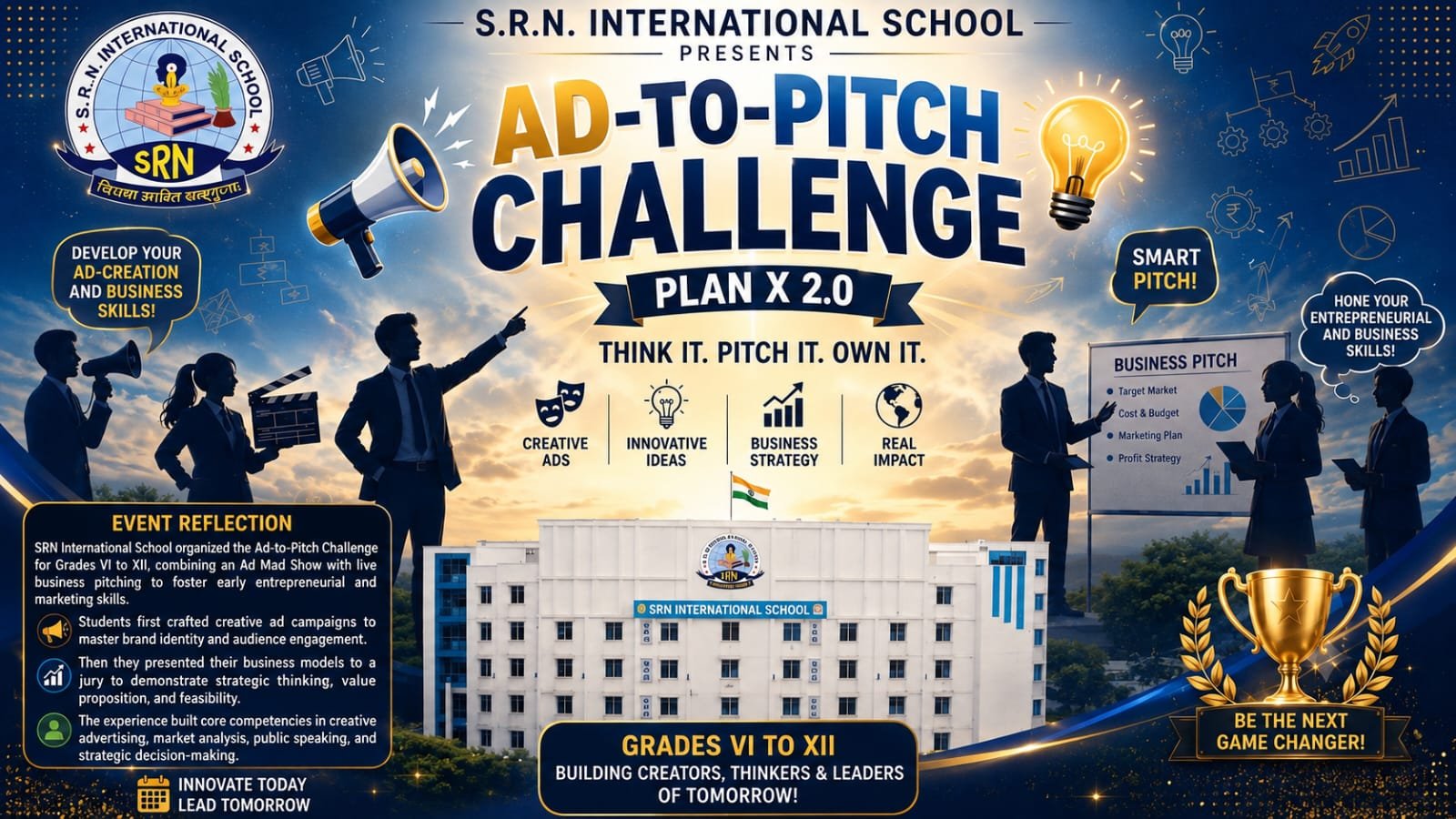
JAIPUR — The SRN Ad-to-Pitch Challenge brought students from Grades VI to XII into a simulated marketplace where they had to do more than present an idea: they first built an advertising concept and then defended a business model before a live jury. According to event information provided by SRN International School, the programme was designed to combine creative communication, market understanding, financial thinking and public speaking in one competitive format.
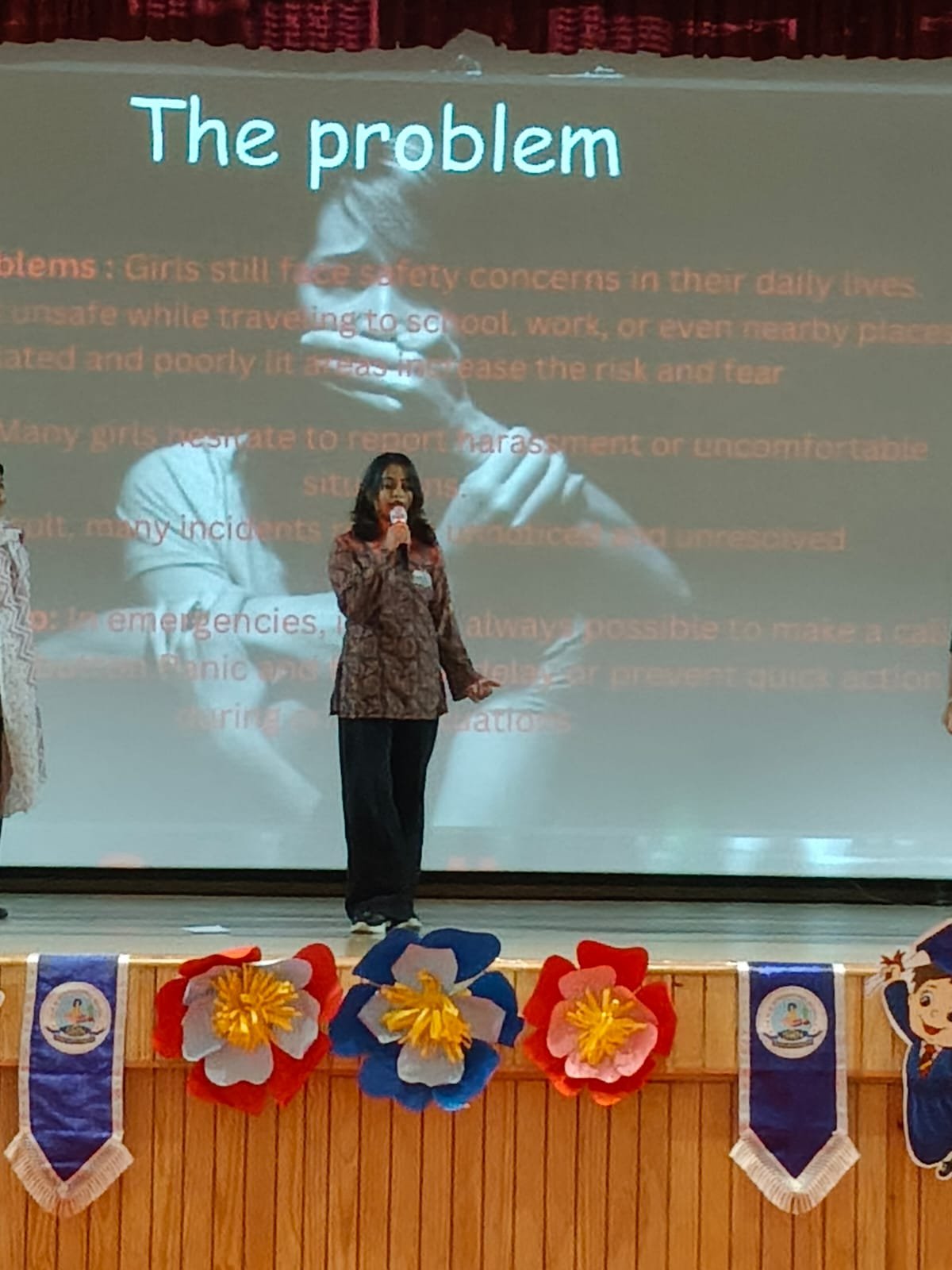
The event moved in two stages. Participants began with “Ad Mad” campaigns focused on branding and audience engagement, before progressing to business pitches in which they explained their proposed product or service, value proposition, market logic and financial feasibility. The jury questioned participants during the live presentations, requiring students to respond in real time rather than rely only on rehearsed speeches.
That structure placed the SRN Ad-to-Pitch Challenge closer to an applied business exercise than a conventional school presentation. Students were expected to think about how an idea would be communicated, whom it would serve, why a customer might choose it and whether the underlying business proposition could make practical sense.
SRN Ad-to-Pitch Challenge Moves from Advertising to Business Pitch
The first phase of the SRN Ad-to-Pitch Challenge focused on advertising. Students developed creative campaigns intended to communicate their ideas quickly and persuasively. The exercise required them to think about brand identity, messaging and the expectations of a target audience — basic questions that sit at the centre of real marketing decisions.
The transition from advertisement to pitch was significant. A strong campaign can attract attention, but a business pitch must explain what is being offered, who needs it, how it differs from alternatives and how the idea could operate sustainably. By combining the two, the competition asked students to connect creativity with commercial reasoning.
Participants then presented their complete business models to an expert panel, according to the school’s event account. Their presentations were assessed not simply as performances but as demonstrations of strategic thinking, value creation and financial feasibility. Live jury questions added an element of unpredictability, testing whether participants understood their own proposals deeply enough to explain or defend them under pressure.
The SRN Ad-to-Pitch Challenge therefore required students to move repeatedly between two modes of thinking: imaginative communication and analytical decision-making. That combination is particularly relevant to entrepreneurship, where an appealing idea is only one part of the challenge and execution, pricing, customer understanding and resource choices can determine whether the concept works.
What Students Were Tested On
The competition tested a broad set of skills. Market analysis was one of the most important because students had to identify the audience for their ideas and consider how a product or service would fit a real or assumed need. Even at school level, that pushes participants beyond the question, “What do I want to create?” towards the more demanding question, “Why would someone want this?”
Public speaking formed another major component. Business pitching requires clarity, structure and brevity. Students had to explain an idea to people who had not developed it themselves, which meant making assumptions visible and communicating the core proposition in accessible language.
The live questioning component raised the difficulty further. A prepared presentation can be memorised; a jury question cannot. Students had to listen, process the question, decide what information mattered and formulate an answer within seconds. That makes the SRN Ad-to-Pitch Challenge an exercise in decision-making as well as presentation.
Financial feasibility was also part of the pitching process, according to the event information. For young participants, the value of this requirement lies less in producing sophisticated financial forecasts and more in recognising that business ideas have costs, prices, resources and trade-offs. A proposal that sounds attractive must still confront practical questions about how it would be delivered and sustained.
SRN Ad-to-Pitch Challenge Tests More Than Presentation Skills
The strongest feature of the format is that the different tasks are interconnected. Branding without customer understanding is weak. A confident pitch without a workable proposition can fail under questioning. A financially sensible idea can struggle if the presenter cannot communicate its value. By putting these elements into the same competition, the school created a setting in which students had to see entrepreneurship as a system rather than a single skill.
That approach also gives younger students exposure to vocabulary and decision frameworks they may encounter later in commerce, economics, management, design, technology or start-up environments. It does not assume that every participant will become an entrepreneur. Instead, it treats entrepreneurial thinking as a practical way to develop initiative, problem-solving and communication.
Awards Recognise Innovation and Communication
Exceptional performances were recognised in multiple categories. The school said the honours included the Best Innovator Award, the Best Business Pitch Award and the Best AdMad Presentation.
The categories reflected the different dimensions of the competition. The Best Innovator Award placed attention on originality and the strength of the underlying idea. The Best Business Pitch Award recognised the ability to turn a concept into a coherent and persuasive business case. The Best AdMad Presentation highlighted the communication and branding side of the challenge.
Individual winners’ names were not included in the material available for publication, and Credent TV is therefore not naming recipients without confirmation. The distinction is important because competition coverage should separate verified award categories from unverified claims about individual results.
Taken together, the award structure reinforced the central design of the SRN Ad-to-Pitch Challenge: creativity, strategy and presentation were treated as related but distinct abilities. That is closer to real business evaluation, where a compelling idea may still require stronger execution, and an effective presentation cannot substitute for a weak commercial proposition.
Background and Context
SRN International School is located at Ramnagariya in Jaipur’s Jagatpura area. Its [official website](https://www.srninternational.org/) describes it as a co-educational day-cum-residential institution affiliated with CBSE and offering a Cambridge pathway. The school’s 2026–27 documents list CBSE affiliation number 1730251, while its academic information shows Entrepreneurship among the subjects offered at the senior-secondary level.
The SRN Ad-to-Pitch Challenge is also consistent with a broader pattern of entrepreneurship-oriented activity at the campus. Earlier in 2026, Yi Jaipur said its Kidpreneur programme at SRN International School concluded with a Mini Marketplace on April 20. According to Yi Jaipur, more than 220 students were engaged across programme sessions, 160-plus young entrepreneurs participated through more than 50 stalls, and students worked on branding, pricing, sales, customer engagement, digital payments and revenue tracking.
That earlier programme and the SRN Ad-to-Pitch Challenge are separate activities, but both use participation and decision-making rather than lecture-only instruction. The recurring emphasis shows students being given opportunities to test business concepts through practical tasks, public interaction and competitive evaluation.
The SRN Ad-to-Pitch Challenge should not be described as a substitute for formal entrepreneurship education, but its design overlaps with several of those learning goals. Students had to consider markets, communicate value, address feasibility and respond to questions — activities that translate abstract business concepts into decisions and explanations.
Why It Matters
School entrepreneurship events are most useful when they move beyond slogans about innovation and give students a structured problem to solve. The SRN Ad-to-Pitch Challenge did that by requiring participants to develop both an outward-facing advertisement and an inward-facing business rationale.
For students in Grades VI to XII, the age range also creates an important progression. Younger participants can begin with creative communication and basic customer thinking, while older students can engage more deeply with market positioning, feasibility and business logic. The same format can therefore test different levels of complexity without losing its core purpose.
The public-speaking component has relevance beyond commerce. Students who can explain an idea clearly, answer difficult questions and adjust their reasoning in response to scrutiny are developing skills useful in academic presentations, interviews, leadership roles and collaborative work.
The financial element matters for another reason. Young people are frequently encouraged to innovate, but innovation without attention to cost, resources or implementation can remain abstract. Asking students to consider feasibility introduces discipline into creativity. It teaches that ideas must operate within constraints and that choices have consequences.
The advertising phase also introduces a form of media literacy. To build a campaign, students have to think about audience, message, attention and persuasion. Those are marketing skills, but they can also help students understand how commercial communication works around them. When taught responsibly, creating advertising can make learners more analytical consumers of advertising as well.
Most importantly, the live jury format creates accountability. Participants cannot control every question, and that uncertainty forces them to understand their proposals rather than simply perform them. The SRN Ad-to-Pitch Challenge therefore gives students a low-risk environment in which to experience a core feature of professional life: decisions and claims are often tested by other people.
The format also changes the role of failure. In a conventional test, a wrong answer may simply cost marks. In a business-pitch simulation, a weak assumption or difficult jury question can become immediate feedback. Students can see where an idea lacks clarity, where a cost has been overlooked or where an audience has not been adequately defined.
That feedback loop is central to entrepreneurial thinking. Ideas are rarely complete at the first attempt. They are tested, challenged and revised. By allowing students to encounter that process before entering university or the workplace, schools can make concepts such as market research, value proposition and financial planning more concrete.
What Happens Next
The school has described the competition as a successful experiential-learning initiative and has recognised outstanding participants across the announced award categories. No further round, external final, commercial incubation programme or follow-up funding process was confirmed in the information available for publication.
Any subsequent mentoring, inter-school expansion or continuation of the SRN Ad-to-Pitch Challenge would therefore require a separate announcement from the school. Until then, the confirmed outcome is the completion of the school-level competition and recognition of student performance in innovation, business pitching and advertising presentation.
For SRN International School, the event adds another practical entrepreneurship activity to a campus that has already hosted market-based learning programmes in 2026. For the students, its value lies in the sequence they experienced: create an idea, communicate it, justify it and answer for it.
That sequence is simple, but it mirrors the pressure points of real enterprise. The SRN Ad-to-Pitch Challenge turned those pressure points into a school competition, giving students an opportunity to practise not only how to make a pitch, but also how to think before making one.
SRN Ad-to-Pitch Challeng, SRN International School Jaipur, young entrepreneurs Jaipur, student entrepreneurship, business pitch competition, Ad Mad competition, entrepreneurship education, student business ideas, experiential learning, school marketing challenge, young innovators, business skills for students, Jaipur school news,
SRN International School, Jaipur, Entrepreneurship, Student Innovation, Business Pitch, Ad Mad, Young Entrepreneurs, Experiential Learning, School Education, Marketing Skills, Business Education, Rajasthan Education
#SRNAdToPitch #YoungEntrepreneurs #StudentInnovation #JaipurEducation #CredentTV