Education
“Maha Parinda Abhiyan” Launched by Deputy CM Dr. Prem Chand Bairwa Under the Leadership of Dr. Bankolia
7 Inspiring Reasons Why the Maha Parinda Abhiyan Is Brilliantly Saving Birds Across Rajasthan
Maha Parinda Abhiyan — a massive, heartfelt campaign to place water and food feeders for birds across India — has taken on a vibrant new momentum in Rajasthan, with a grand state-level launch in Jaipur led by the Universal Human Rights Council (UHRC) and graced by Rajasthan’s Deputy Chief Minister, Dr. Prem Chand Bairwa. In a time when rising temperatures are devastating bird populations and urban development is erasing the natural havens that birds once called home, this campaign arrives as a remarkable act of collective compassion.
With hundreds of parindas (bird water feeders) installed at multiple locations across Jaipur, this initiative is not just about placing clay pots of water — it is about restoring a relationship between human beings and the birds that share our cities, streets, and rooftops.
Table of Contents
- What Is the Maha Parinda Abhiyan?
- A Grand Launch: Deputy CM Dr. Bairwa Inaugurates the Drive
- The Alarming Crisis Facing Birds in Indian Summers
- Sparrows, Mynas, and the Silent Disappearance
- Why the Maha Parinda Abhiyan Matters More Than Ever
- How You Can Join the Maha Parinda Abhiyan
- UHRC’s Nationwide Vision: All States, One Mission
- Simple Actions That Can Save a Life This Summer
What Is the Maha Parinda Abhiyan?
The Maha Parinda Abhiyan is a nationwide bird welfare campaign organised by the Universal Human Rights Council (UHRC), a human rights and social welfare organisation operating across India. The word Parinda is a Hindi and Urdu term for “bird,” and the campaign takes its name from the age-old Indian tradition of placing clay water pots and feeders for birds during the scorching summer months.
At its heart, the campaign mobilises ordinary citizens, schools, social organisations, and government officials to install water and food feeders — known as parindas — at homes, offices, temples, parks, and public spaces. These small but powerful acts help birds survive the deadly combination of extreme heat, water scarcity, and habitat loss that makes Indian summers increasingly dangerous for wildlife.
The Maha Parinda Abhiyan is a call to action that requires no special skills, no large donations, and no official affiliation — just a willing heart and a vessel of clean water.
A Grand Launch: Deputy CM Dr. Bairwa Inaugurates the Drive
The Jaipur chapter of the Maha Parinda Abhiyan was inaugurated in a ceremony that brought together government dignitaries, civil society leaders, and dedicated grassroots volunteers.
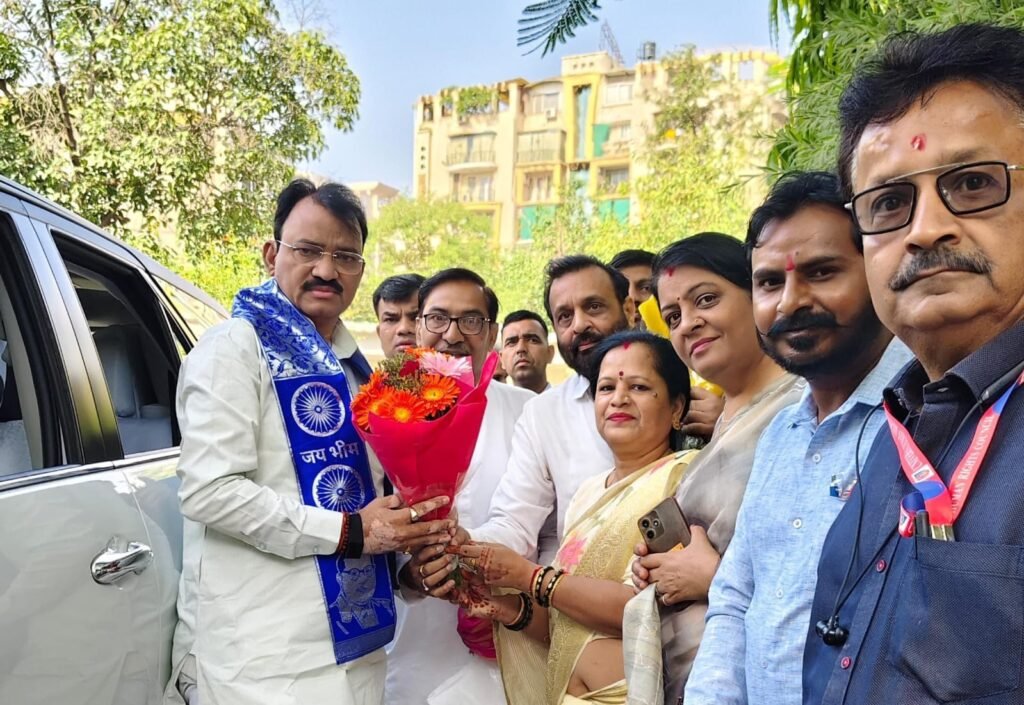
Deputy Chief Minister of Rajasthan, Dr. Prem Chand Bairwa, served as the Chief Guest and officially launched the Maha Parinda Abhiyan campaign. He was accorded a warm welcome by the UHRC team, who presented him with a copy of the Preamble to the Constitution of India, a dupatta, and a special memento bearing the image of Dr. B.R. Ambedkar — symbols of constitutional values, dignity, and social justice that underpin everything UHRC stands for.
The programme was chaired and inaugurated by Dr. Tarun Bankolia, National President of UHRC, who opened the event with an impassioned address connecting the chirping of sparrows and mynas near our homes with our collective responsibility to protect them.
Indra Raj Meena, State President of UHRC, served as the Distinguished Guest, while Ravi Shankar Sharma, District President, also participated in the ceremony. A strong contingent of office-bearers lent their presence to the event, including National Advisor Sandeep Sharma, State Vice President Devnarayan Kholiya, General Secretary Surajbhan Bunkar, Organisation Secretary Ramlal Dabkiya, State Secretary Sunil Kumar Verma, Women’s President Smt. Santosh Sharma, District Vice President Mukesh Sharma, General Secretary Shyam Mohan Vyas, Treasurer Sushil Kumar Sharma, and Executive Member Smt. Anita Sharma, among many others.
Educationist Rakshita Negi, Women’s President, was also present, reflecting the campaign’s strong emphasis on women’s participation in conservation efforts.
The Alarming Crisis Facing Birds in Indian Summers
To understand why the Maha Parinda Abhiyan is so urgently needed, one must look at the dire situation facing India’s birds during the summer months.
India experienced one of its hottest summers in recent years, with temperatures reaching as high as 50°C in some parts of the country. Birds, bats, and reptiles — particularly those inhabiting urban spaces — faced severe dehydration and heat-associated illness, while the plight of non-human lives remained low on the priority list.
Small, territorial birds such as sparrows, parakeets, crows, and finches get dehydrated often, and experts suggest that citizens can implement easy, cost-effective measures like setting up food and water bowls in gardens to help urban birds cope with the heat.

The situation is compounded by rapid urbanisation. Glass-fronted buildings, concrete jungles, and the disappearance of traditional earthen homes with nooks and crevices have eliminated the natural nesting sites that birds like sparrows depended on for generations. Add to this the proliferation of mobile towers, chemical pesticides, and noise pollution, and you have a perfect storm driving bird populations toward steep decline.
This is the crisis the Maha Parinda Abhiyan is determined to address — one water feeder at a time.
Sparrows, Mynas, and the Silent Disappearance
Dr. Tarun Bankolia, opening the Jaipur ceremony, spoke movingly about the joy that birds bring to our mornings — the chirping of sparrows, the melodious call of mynas, the energetic hopping of small birds near doorsteps that delights children and adults alike.
That morning music, however, is growing increasingly rare.
According to a study by the Indian Council of Agricultural Research (ICAR), the house sparrow population in Andhra Pradesh had reduced by up to 88%, while in states like Gujarat, Kerala, and Rajasthan, the count had dropped by 20%.
The common House Sparrow that once lived in the cavities of houses and nibbled off leftover food now sits on the red list of endangered species of the International Union for Conservation of Nature (IUCN).
Why Are Sparrows Disappearing from Rajasthan?
Urbanisation and unplanned development are among the most important causes of the decline in sparrow populations. Modern architecture has replaced older buildings that had nooks and cavities essential for nesting. Additionally, the widespread use of insecticides in modern agriculture has reduced the insect populations that form a critical part of young sparrows’ diets.
Rajasthan’s desert climate makes the situation even more acute. Unlike other states with natural water bodies and dense green cover, Rajasthan’s birds must depend almost entirely on human goodwill during the summer season to find drinking water.
In the summer of 2020, Rajasthan saw temperatures soar beyond 50°C, with even groundwater receding and birds and animals having no respite.
The Maha Parinda Abhiyan directly addresses this lethal gap.
Why the Maha Parinda Abhiyan Matters More Than Ever
State President Indra Raj Meena articulated the central human truth of this campaign with simple but powerful words: many birds and animals die in summer due to a lack of water. A small effort by people — placing water feeders near homes — can quench the thirst of birds and literally save their lives.
This is not hyperbole. It is biology.
Installing proper bowls for bird feed and water, especially during summers, ensures that birds are safeguarded from heat exhaustion and dehydration.
Beyond individual birds, the ecological stakes are enormous. Sparrows and mynas play vital roles in pest control and seed dispersal. Sparrows act as pest control and are extremely important in helping spread green cover as they disperse seeds over vast tracts of land.
When we lose birds, we lose a silent army of ecosystem engineers. When we save them, we invest in the health of our own environment, our agriculture, and our urban green spaces.
The Maha Parinda Abhiyan, by bringing together government, civil society, and ordinary citizens in a single shared act of care, has the potential to create a ripple effect that goes far beyond Jaipur.
How You Can Join the Maha Parinda Abhiyan
Dr. Bankolia made a heartfelt public appeal during the Jaipur launch: that people not only love birds but also take special care of them during summer — and contribute to this noble cause by placing as many parindas as possible near their homes.
Joining the Maha Parinda Abhiyan is beautifully simple. Here is how:
Step 1 — Set Up a Water Feeder: Place a clay pot, earthen bowl, or any shallow container filled with clean, fresh water in a visible spot near your window, terrace, balcony, or garden. Change the water every day to prevent mosquito breeding and keep it clean for the birds.
Step 2 — Add a Food Source: Place a small tray of rice grains, millet seeds, or small bird-friendly grains near the water feeder. Black oil sunflower seeds are among the highest quality options for sparrows, while platform feeders suit natural foods like mealworms.
Step 3 — Position It Thoughtfully: Place the feeder in a shaded spot to keep the water cool, away from direct afternoon sunlight. Keep it out of reach of cats and other predators.
Step 4 — Spread the Word: Encourage your neighbours, society, school, or office to do the same. The Maha Parinda Abhiyan thrives on community participation.
Step 5 — Connect With UHRC: Reach out to the Universal Human Rights Council to participate in organised drives, seminars, and collective feeder installation events in your city.
UHRC’s Nationwide Vision: All States, One Mission
What makes the Maha Parinda Abhiyan particularly remarkable is its scale and ambition. The campaign is not confined to Rajasthan alone.
Dr. Bankolia announced that the Parinda Maha Abhiyan has been organised by UHRC across all states of India, making it one of the country’s most geographically extensive bird welfare drives. Each chapter of UHRC coordinates local activities — installation drives, awareness seminars, and school outreach — tailored to the specific ecological conditions of their region.
In Rajasthan, the extreme summer heat makes the campaign especially critical. In coastal states, the challenge may be different — but the principle remains universal: birds need water, food, and safe nesting spaces, and humans are uniquely placed to provide them.
A simple idea — placing water for birds — proved capable of creating massive national impact, as seen when a community in Barmer used recycled tin cans as birdbaths, inspiring a movement that spread from Raipur to Pune and from Gujarat to Bikaner.
The Maha Parinda Abhiyan builds on this tradition of grassroots compassion, giving it an organised, sustained, and inclusive structure.
8. Simple Actions That Can Save a Life This Summer
Here is a quick-reference guide to making your home bird-friendly this summer:
Action Benefit Effort Required Place a clay water bowl Prevents dehydration and death Very Low Add grain or seeds nearby Provides essential nutrition Very Low Install a birdhouse Provides nesting space Low–Medium Plant native trees or shrubs Creates natural habitat Medium Avoid pesticides in garden Protects insect-based food chain Low Share the campaign online Multiplies community participation Very Low
Maintenance of natural habitats like water puddles, gardens, and lakes provides birds a place to inhabit, and every individual should be responsible and contribute.
Every Drop Counts, Every Feeder Matters
The Maha Parinda Abhiyan is more than an environmental drive. It is a statement of values — that human progress need not come at the cost of the natural world we share with millions of creatures. It is a reminder that the sparrow chirping outside your window in the morning is not just background noise; it is a sign of a living, breathing ecosystem that depends on our choices.
Deputy CM Dr. Prem Chand Bairwa‘s presence at the campaign’s launch signals something important: that protecting birds is not just the work of NGOs and environmentalists, but a shared civic and governmental responsibility. When the state and civil society come together around a simple clay pot of water, it sends a message that resonates far beyond any single event.
As temperatures across Rajasthan climb toward their summer peak, the hundreds of parindas installed across Jaipur through the Maha Parinda Abhiyan will stand as small, quiet miracles — offering water, safety, and life to the birds who ask nothing of us except a chance to survive.