Breaking News
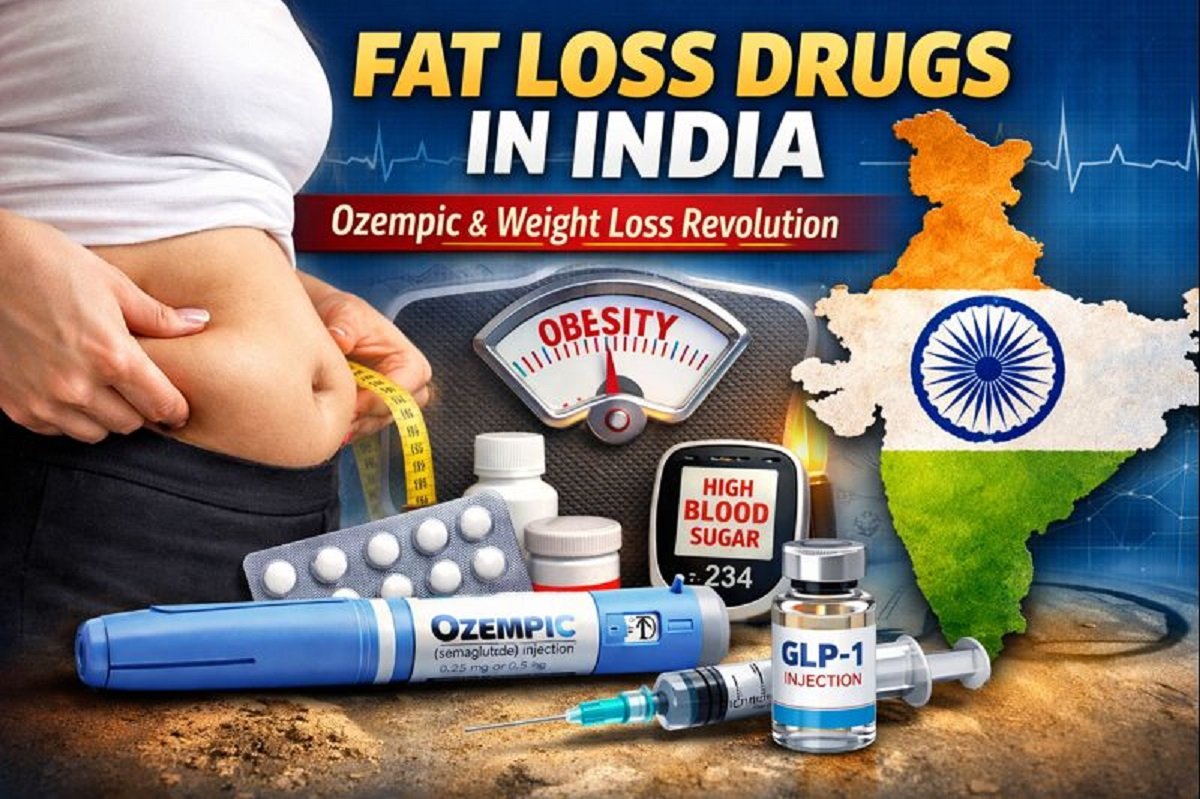
Fat Loss Drugs in India are gaining massive attention after Ozempic’s launch-

- Ozempic (Semaglutide)
- Wegovy
- Rybelsus (oral version)
- Mounjaro (Tirzepatide – not yet widely available in India)
- Reduced hunger
- Slower digestion
- Lower calorie intake
- Significant weight reduction over months
- Increasing insulin secretion
- Slowing stomach emptying
- Reducing hunger signals to the brain
- Controlling blood sugar levels
- Managing diabetes
- Tackling obesity, which is a major risk factor
- Average weight loss of 10–15% over one year
- Improved insulin sensitivity
- Reduced cardiovascular risk
- Clinically proven weight loss
- Better blood sugar control
- Reduced risk of heart disease
- Improved metabolic health
- Appetite regulation without extreme dieting
- Nausea
- Vomiting
- Diarrhea
- Constipation
- Fatigue
- Pancreatitis
- Gallbladder issues
- Thyroid tumors (observed in animal studies)
- Adults with Type-2 diabetes
- Individuals with BMI above 30
- Patients with obesity-related health conditions
- Pregnant or breastfeeding women
- People with thyroid cancer history
- Patients with severe gastrointestinal disorders
- ₹8,000 to ₹15,000 (varies by dosage)
- Nutrition education
- Physical activity promotion
- Early screening programs
- Are these drugs being misused for cosmetic weight loss?
- Will shortages affect diabetic patients?
- Is society promoting medication over healthy habits?
- Wider availability
- Possible price reductions
- Stricter prescription guidelines
Contents
Jaipur, Dec.17,2025:Fat Loss Drugs in India have become one of the most discussed topics in the health and pharmaceutical space after the official launch of Ozempic by Danish drugmaker Novo Nordisk. Originally developed to treat Type-2 diabetes, this injectable medicine is now being widely talked about for its remarkable weight loss effects.
From celebrities to medical experts, everyone seems to be debating whether these drugs are a breakthrough solution for obesity or a risky shortcut. With India facing a twin epidemic of diabetes and obesity, the timing of Ozempic’s entry could not be more critical.
What Are Fat Loss Drugs in India
Fat Loss Drugs in India primarily refer to a new class of medicines based on GLP-1 (Glucagon-Like Peptide-1) receptor agonists. These drugs were initially created to help people manage blood sugar levels but later showed strong results in reducing appetite and body weight.
Popular GLP-1 based drugs include
These medicines are taken either as weekly injections or daily pills, under medical supervision.
A Game-Changer
The launch of Ozempic has pushed Fat Loss Drugs in India into the mainstream conversation. Novo Nordisk introduced Ozempic as a Type-2 diabetes treatment, but global studies and real-world usage revealed its strong impact on fat loss and appetite control.
According to multiple international reports, patients using Ozempic experienced
This has made Ozempic one of the most talked-about drugs worldwide.
How GLP-1 Drugs Work in the Human Body
To understand Fat Loss Drugs in India, it is important to understand how GLP-1 hormones function.
GLP-1 is a natural hormone released by the intestines after eating food. It helps the body by
GLP-1 based drugs mimic this hormone, making the body feel full faster and for longer durations. As a result, calorie intake reduces naturally, leading to gradual and sustained fat loss.
Fat Loss Drugs in India and the Diabetes Crisis
India is often called the diabetes capital of the world. A 2023 study published in The Lancet Diabetes & Endocrinology revealed that over 101 million people in India are living with diabetes, with the majority suffering from Type-2 diabetes.
Despite awareness campaigns under the National Health Mission (NHM), diabetes remains a major public health challenge.
Fat Loss Drugs in India are now being seen as a dual-purpose solution
Scientific Evidence Behind Ozempic and Weight Loss
Multiple international clinical trials have demonstrated the effectiveness of semaglutide-based drugs.
Key findings include
A study published in The New England Journal of Medicine confirmed that patients using semaglutide lost significantly more weight compared to placebo groups.
Benefits of Fat Loss Drugs in India
The growing popularity of Fat Loss Drugs in India is driven by several benefits
Key Advantages
For patients struggling with obesity and diabetes together, these drugs offer a medical alternative to bariatric surgery.
Risks, Side Effects, and Medical Warnings
Despite the hype, Fat Loss Drugs in India are not risk-free.
Common side effects include
Serious but rare risks
Doctors strongly advise against self-medication. These drugs should only be used under professional medical supervision.
Who Should and Should Not Use These Drugs
Fat Loss Drugs in India are generally prescribed for
Not recommended for
Medical screening is essential before starting treatment.
Cost, Availability, and Accessibility in India
One of the biggest concerns around Fat Loss Drugs in India is affordability.
Estimated monthly cost
Currently, these drugs are not covered under most government schemes, making them inaccessible for a large section of the population.
Government Health Programs vs Ground Reality
While the Ministry of Health promotes lifestyle changes under NHM, the growing burden of diabetes and obesity highlights a gap between policy and ground-level implementation.
Experts believe medicines alone cannot solve the problem without
Expert Opinions on Fat Loss Drugs in India
Health experts caution against calling these drugs “miracle solutions.”
According to endocrinologists:
“GLP-1 drugs are effective medical tools, not cosmetic weight loss shortcuts.”
Long-term lifestyle changes remain essential for sustainable health outcomes.
Ethical and Social Concerns Around Weight Loss Drugs
The rise of Fat Loss Drugs in India has sparked ethical debates:
These concerns need urgent regulatory attention.
The Future of Fat Loss Drugs in India
The future looks promising yet cautious. Pharmaceutical companies are investing heavily in next-generation GLP-1 drugs, while Indian regulators are closely monitoring usage patterns.
Experts predict
Miracle Cure or Medical Tool
Fat Loss Drugs in India represent a significant medical advancement in tackling diabetes and obesity. However, they are not magic bullets. Used responsibly, under medical guidance, they can improve lives. Misused, they could create new health risks.
As India battles a growing lifestyle disease crisis, the real solution lies in a balanced approach combining medicine, awareness, and healthy living.
We do not provide advice for any medicine; this is only for informational purposes.
Breaking News
Bangladesh Hindu Lynching Shocks World- Brutal Truths Behind the Horrifying Mob Killing-

Contents
Bangladesh, Dec,19,2025:Bangladesh Hindu lynching has once again exposed the dark underbelly of mob violence and religious extremism gripping parts of the country. In a horrifying incident from Mymensingh district, a Hindu युवक was brutally beaten to death by a mob and his body later tied to a tree and set on fire.
The gruesome killing has shaken Bangladesh, intensified communal tensions, and drawn sharp reactions from political leaders, civil society, and minority rights groups.
This Bangladesh Hindu lynching incident occurred amid violent protests following the death of a prominent protest leader, turning an already volatile situation into a symbol of unchecked radicalism.
What Happened in Mymensingh
The Bangladesh Hindu lynching took place in Bhaluka upazila of Mymensingh district. According to Bangladeshi media reports, the victim was accused of making derogatory remarks about Islam and Prophet Muhammad during a factory event organized on World Arabic Language Day.
As the allegation spread rapidly, an angry mob gathered, chanting religious slogans. What followed was a disturbing display of mob justice that ended in death.
Who Was Dipu Chandra Das
The victim of the Bangladesh Hindu lynching has been identified as 30-year-old Dipu Chandra Das, a worker at a local factory.
Colleagues described him as a quiet individual with no prior history of communal conflict. However, a sudden accusation—still under investigation—was enough to seal his fate.
Human rights activists argue that the killing reflects how vulnerable minorities remain during times of political and social unrest.
Bangladesh Hindu Lynching and Mob Radicalization
The Bangladesh Hindu lynching highlights a dangerous trend: mobs acting as judge, jury, and executioner.
Eyewitness accounts suggest that protesters shouted extremist slogans while assaulting Dipu. After he succumbed to injuries, the violence escalated further when his body was tied to a tree and burned.
This level of brutality has raised alarms about the normalization of extremist behaviour during protests.
Timeline of Events Leading to the Killing
Bangladesh Hindu lynching – key moments
- Allegation of religious insult surfaces
- Crowd gathers near factory premises
- Physical assault begins
- Victim dies due to injuries
- Body tied to a tree
- Mob sets the body on fire
Each step shows a complete breakdown of law and order.
The Chilling Details of the Lynching
What makes the Bangladesh Hindu lynching particularly horrifying is the post-death violence. Videos and photos circulating online show the mob continuing its assault even after Dipu was lifeless.
Local residents reported panic and fear, with many locking themselves indoors as the mob roamed freely.
Such incidents deepen insecurity among minority communities already living under constant fear.
Bangladesh Protests and Rising Extremism
The Bangladesh Hindu lynching occurred during violent protests following the death of July uprising leader Sharif Usman Hadi.
What began as political unrest soon took a communal turn, with extremist elements exploiting emotions to target minorities.
Analysts warn that mixing political anger with religious radicalism creates a lethal combination.
Interim Government’s Response to Bangladesh Hindu Lynching
The interim government led by Muhammad Yunus strongly condemned the Bangladesh Hindu lynching.
In an official statement, the government said:
“There is no place for such violence in the new Bangladesh. Those responsible for this heinous crime will not be spared.”
The administration also urged citizens to reject hatred and violence during this sensitive period.
Police Investigation and Current Status
Local authorities confirmed the death and stated that Dipu Chandra Das’s body is in police custody.
According to Bhaluka Upazila Executive Officer Mohammad Firoz Hossain, investigations are ongoing. However, no arrests have been made yet, raising concerns over accountability.
The delay has fuelled anger among minority groups and rights organizations.
Political Reactions Inside Bangladesh
Awami League leader Mohammad Ali Arafat condemned the Bangladesh Hindu lynching, warning that the country is sliding toward extremism.
Opposition leaders and civil society members echoed similar concerns, urging immediate action to restore law and order.
Impact on Hindu Minority in Bangladesh
The Bangladesh Hindu lynching has deepened fear among the Hindu community, which already faces sporadic violence.
Many families are reportedly reconsidering public participation in cultural or religious events due to safety concerns.
This incident underscores the fragile position of minorities during national unrest.
International Reactions and Human Rights Concerns
Global human rights organizations have taken note of the Bangladesh Hindu lynching, calling for a transparent investigation.
International watchdogs stress that mob violence over alleged blasphemy violates fundamental human rights.
Why Bangladesh Hindu Lynching Matters Beyond Borders
The Bangladesh Hindu lynching is not just a domestic issue. It reflects a broader global concern where misinformation, extremism, and mob justice are replacing rule of law.
For South Asia, such incidents risk destabilizing regional harmony and diplomatic relations.
The Role of Social Media and Rumors
Unverified claims spread rapidly on social media played a key role in the Bangladesh Hindu lynching.
Experts stress the need for digital responsibility, fact-checking, and swift government response to online hate.
A Test for Bangladesh’s Future
The Bangladesh Hindu lynching is a grim reminder of how quickly society can descend into chaos when extremism overrides humanity.
For Bangladesh, this moment is a test—of governance, justice, and its commitment to protecting minorities.
Bihar
The Nitish Kumar Hijab Controversy has sparked criticism from Arab media-

Contents
Bihar, Dec.17,2025:The Nitish Kumar Hijab Controversy refers to an incident that occurred on December 15, when Bihar Chief Minister Nitish Kumar was distributing appointment letters to newly recruited AYUSH doctors. During the ceremony, Nitish Kumar was seen pulling the hijab off the face of a Muslim woman doctor in front of an audience.
The moment, captured on camera, quickly went viral on social media platforms. Many viewers described the act as inappropriate, insensitive, and a violation of personal and religious dignity. While supporters attempted to downplay the incident, critics argued that the optics were deeply damaging.
The Incident That Triggered Nationwide Shock
In India, the hijab is not just a piece of clothing—it represents religious identity, personal choice, and constitutional freedom. The visual of a senior political leader forcibly removing a woman’s hijab shocked many across political and social spectrums.
The Nitish Kumar Hijab Controversy raised fundamental questions
- Was consent considered
- Should a constitutional authority behave this way
- What message does this send to minority communities
These questions soon echoed beyond India’s borders.
Why Arab Media Reacted Strongly
Arab media outlets, particularly in Qatar and the Gulf region, highlighted the incident as an example of rising insensitivity toward Muslims in India. Editorials and opinion pieces questioned India’s commitment to religious freedom, a value it often promotes on global platforms.
The Nitish Kumar Hijab Controversy was framed as symbolic rather than isolated—suggesting a pattern rather than a one-off mistake. This framing intensified the criticism and expanded the debate.
Coverage in Turkey, Qatar, and the Muslim World
Media in Turkey described the act as humiliating and disrespectful toward Muslim women. In Qatar, commentators linked the controversy to broader discussions around minority rights in India.
The Muslim world closely watches India due to
- Its large Muslim population
- Strong trade ties
- Millions of Indian workers in Gulf countries
The Nitish Kumar Hijab Controversy therefore resonated deeply.
Pakistan’s Narrative and Regional Propaganda
Predictably, Pakistani media seized the opportunity to reinforce its long-standing narrative that “being Muslim in India is unsafe.” Television debates and social media campaigns amplified the incident as proof of systemic bias.
While such narratives are often politically motivated, incidents like the Nitish Kumar Hijab Controversy provide ready material for hostile propaganda.
Nitish Kumar’s Political Image vs Reality
Nitish Kumar has served as Bihar’s Chief Minister for nearly two decades. He has traditionally been seen as a leader with a secular and inclusive image. That is why this incident surprised even his long-time supporters.
Political analysts argue that the Nitish Kumar Hijab Controversy does not align with the persona he cultivated over the years, making the incident even more troubling.
Opposition Attacks and Health Concerns Debate
Opposition parties were quick to attack. Some leaders went as far as questioning Nitish Kumar’s mental and physical fitness to hold public office. They argued that such behaviour reflects a decline in judgment.
While health-related speculation remains controversial, the political pressure surrounding the Nitish Kumar Hijab Controversy continues to mount.
JD(U)’s Response and Political Silence
When asked about the controversy, a spokesperson from Nitish Kumar’s party, Janata Dal (United), stated that the issue was “outside their jurisdiction.” This response was widely criticized as evasive.
The lack of a clear apology or explanation further fuelled outrage, making the Nitish Kumar Hijab Controversy linger in public discourse.
Comparison With the Nupur Sharma Case
In June 2022, BJP leader Nupur Sharma made controversial remarks about Prophet Muhammad. The backlash from Muslim countries was swift and severe, leading to her suspension from the party.
Many observers now compare that episode with the Nitish Kumar Hijab Controversy, noting similarities in international reaction and diplomatic discomfort.
PM Modi’s West Asia Visit
The controversy surfaced just as Prime Minister Narendra Modi was on an official visit to West Asia. This coincidence made the situation diplomatically awkward.
India relies heavily on West Asia for
- Energy imports
- Trade partnerships
- Employment for Indian expatriates
Any controversy like the Nitish Kumar Hijab Controversy risks undermining these relationships.
India’s Strategic Interests in the Middle East
India’s engagement with the Middle East goes beyond politics—it includes economics, culture, and people-to-people ties. Over 8 million Indians live and work in Gulf countries.
Diplomatic experts warn that repeated controversies involving religious sensitivities could slowly erode India’s soft power, with the Nitish Kumar Hijab Controversy serving as a cautionary example.
Impact on India’s Soft Power and Diplomacy
Soft power is built on perception, values, and trust. Incidents that appear disrespectful to religious practices weaken India’s narrative as a pluralistic democracy.
The Nitish Kumar Hijab Controversy demonstrates how a single domestic event can ripple across borders, impacting diplomacy and global perception.
Experts’ Views on Religious Sensitivity
Human rights experts emphasize that public officials must show extra sensitivity toward religious symbols, especially in a diverse society like India.
They argue that the Nitish Kumar Hijab Controversy should prompt
- Better training for public officials
- Clear protocols during public functions
- Stronger accountability mechanisms
What This Means for Indian Politics
Domestically, the controversy may
- Alienate minority voters
- Strengthen opposition narratives
- Force political parties to rethink public conduct
The Nitish Kumar Hijab Controversy is more than a fleeting political storm. It is a reminder that leadership behaviour carries weight far beyond immediate surroundings. In an interconnected world, actions taken on a small stage can echo globally.
Breaking News
The Bengaluru Digital Fraud Police Scam exposes a terrifying cybercrime where fake police threatened a woman about her son, forcing her to sell property and lose ₹2 crore-

Bengaluru, Dec.16,2025:The Bengaluru Digital Fraud Police Scam is a chilling reminder that cybercrime today is no longer limited to phishing emails or fake lottery messages. It now involves emotional manipulation, impersonation of authorities, and digital surveillance-style intimidation.
In this case, criminals posed as law enforcement officers and created a fabricated criminal narrative linked to the victim’s Aadhaar card, leaving her terrified for her son’s safety.
Who Is the Victim
According to police sources, the victim has been identified as Babita Das, a software technician working in Bengaluru.
Key details
- Resident of Vignan Nagar
- Living in the same apartment for over 10 years
- Financially independent and digitally active
- Mother of a young son
Despite her professional background, she fell prey to the Bengaluru Digital Fraud Police Scam, proving that cybercrime spares no demographic.
How the Scam Began
The scam started with what seemed like a routine phone call from a man claiming to be a courier official.
He informed the victim that
- A suspicious parcel had been seized
- The parcel was linked to her Aadhaar card
- Police were investigating the matter
Fake Police Narrative and Aadhaar Threat
Soon after, another call followed—this time from someone posing as a senior police officer.
The fraudster alleged that
- Illegal materials were linked to her identity
- A criminal case could be registered
- Her family could face consequences
The Bengaluru Digital Fraud Police Scam relied heavily on exploiting trust in law enforcement and fear of legal trouble.
Psychological Blackmail Using Child Safety
The most disturbing aspect of the Bengaluru Digital Fraud Police Scam was the emotional blackmail involving the victim’s son.
The fake officer warned
“If you don’t cooperate, your son could be in danger.”
This single threat shattered the woman’s emotional stability, pushing her into complete compliance.
A Critical Red Flag
The scammers instructed the woman to
- Download a specific mobile application
- Stay connected continuously
- Avoid contacting anyone else
Such apps often allow
- Screen monitoring
- Call surveillance
- Psychological isolation
This step is a known pattern in many digital arrest scams reported nationwide.
Selling Property Under Fear
As the pressure intensified, the victim was told to urgently arrange money to “close the case”.
With no liquid funds available, she
- Sold her Malur plot at a low price
- Sold her Vignan Nagar flat
- Acted under extreme mental stress
The Bengaluru Digital Fraud Police Scam thus resulted in permanent asset loss—not just cash theft.
How ₹2 Crore Was Transferred
After selling her properties, the victim
- Transferred ₹2 crore
- Sent money to accounts provided by fraudsters
- Was assured the amount would be refunded
Such fraudulent bank transfers are often routed through mule accounts, making recovery difficult
Final Trap at the Police Station
In the final stage of the Bengaluru Digital Fraud Police Scam, the fraudsters instructed her to visit a nearby police station to “complete formalities”.
The moment she reached
- The phone call was disconnected
- All numbers were switched off
- The truth became painfully clear
Realisation of the Fraud
Standing inside an actual police station, the woman realised she had been deceived.
Officials confirmed
- No such case existed
- No parcel was seized
- No police officer had contacted her
The emotional collapse that followed was devastating.
Police Complaint and Investigation
The victim filed an official complaint at:
Whitefield Cyber Crime Police Station, Bengaluru
Police have
- Registered an FIR
- Initiated digital trail analysis
- Contacted banks for transaction tracking
However, officials admit recovery remains challenging due to cross-state cyber networks.
Rise of Digital Arrest Scams in India
The Bengaluru Digital Fraud Police Scam is part of a growing trend known as “digital arrest scams”.
Key features
- Fake police or CBI officers
- Aadhaar or SIM misuse claims
- Threats of arrest or family harm
The Ministry of Home Affairs has issued multiple advisories
Why Educated Professionals Are Also Vulnerable
Contrary to popular belief, cybercrime experts say
- Education does not equal immunity
- Fear overrides logic
- Authority impersonation is highly effective
The Bengaluru Digital Fraud Police Scam proves emotional vulnerability can affect anyone.
Expert Warnings and Cyber Safety Tips
Cybersecurity specialists advise citizens to
- Never trust calls claiming legal action
- Avoid downloading unknown apps
- Verify through official police numbers
- Report immediately to cybercrime portals
What the Law Says About Such Frauds
Under Indian law, such crimes fall under
- IPC Sections for cheating and impersonation
- IT Act provisions on digital fraud
- Organised cybercrime statutes
Convictions can lead to severe punishment if culprits are caught.
A Wake-Up Call for Digital India
The Bengaluru Digital Fraud Police Scam is not just a crime story—it is a warning.
A system built on digital trust must be protected by digital awareness. Until citizens learn to pause, verify, and question authority-based threats, cybercriminals will continue to exploit fear.
Breaking News
The MNREGA Name Change Bill Protest intensifies as Priyanka Gandhi and Shashi Tharoor slam the government in Parliament-

Contents
New Delhi,Dec.16,2025:The MNREGA Name Change Bill Protest is not merely about altering the title of a welfare scheme; it represents a larger ideological and constitutional conflict over decentralisation, workers’ rights, and federal responsibility. Introduced without extensive consultation, the proposed law seeks to repeal MNREGA and replace it with a new framework, triggering widespread outrage among opposition parties.
What Is MNREGA and Why It Matters
Launched in 2005, MNREGA guarantees 100 days of wage employment to every rural household willing to do unskilled manual work. It is the world’s largest employment guarantee programme, reaching millions of families annually.
According to official data from the Ministry of Rural Development
MNREGA has played a crucial role in
- Reducing rural poverty
- Preventing distress migration
- Strengthening village infrastructure
- Empowering women and marginalised communities
Priyanka Gandhi’s Emotional Speech in Parliament
During the MNREGA Name Change Bill Protest, Priyanka Gandhi reminded the House that the Act was passed with near-unanimous support across political parties.
She stated that MNREGA transformed rural India by providing dignity of labour and legal employment rights to the poorest citizens.
“This law was revolutionary when it was passed. It gave the poorest Indian a legal guarantee of work,” she asserted.
“Mahatma Gandhi Is Not My Family, But He Belongs to the Nation”
One of the most powerful moments of the MNREGA Name Change Bill Protest came when Priyanka Gandhi addressed the removal of Mahatma Gandhi’s name from the scheme.
“Mahatma Gandhi is not from my family, but he is like family to the entire nation,” she said, drawing loud desk-thumping from opposition benches.
Her statement resonated beyond Parliament, echoing public sentiment that Gandhi’s legacy transcends political ownership.
Constitutional Concerns and the 73rd Amendment
Priyanka Gandhi strongly argued that the new bill violates the 73rd Constitutional Amendment, which empowers Panchayati Raj institutions.
Under MNREGA
- Funds are demand-driven
- Employment is legally guaranteed
- Gram Sabhas play a central role
The new law, she warned, allows the Centre to pre-determine budgets, undermining local self-governance.
Impact on Gram Sabhas and Local Governance
A major highlight of the MNREGA Name Change Bill Protest was the allegation that Gram Sabha powers are being diluted.
According to Priyanka Gandhi
- Decision-making is being centralised
- Local participation is weakened
- The spirit of grassroots democracy is threatened
She described the move as contrary to the Constitution’s core philosophy of empowering citizens at the lowest level.
Financial Burden on States
Currently, MNREGA is funded with 90% central assistance. The proposed law reduces this share to 60% for certain states, shifting the burden to state governments.
This change, critics argue, could
- Strain already fragile state finances
- Reduce employment generation
- Create regional inequalities
Employment Days Increased, Wages Ignored
While the government claims to increase employment from 100 to 125 days, Priyanka Gandhi highlighted a glaring omission during the MNREGA Name Change Bill Protest—no increase in wages.
With inflation rising, stagnant wages could
- Nullify benefits of additional workdays
- Push workers deeper into poverty
- Reduce programme effectiveness
Shashi Tharoor Calls Name Change “Unethical”
Senior Congress MP Shashi Tharoor strongly criticised the renaming of MNREGA.
“Removing Mahatma Gandhi’s name from this historic scheme is unethical,” he said.
Tharoor emphasised that Gandhi symbolises moral leadership, non-violence, and inclusive development—values deeply embedded in MNREGA’s philosophy.
Political Reactions and Opposition Unity
The MNREGA Name Change Bill Protest has united opposition parties, cutting across ideological differences.
Several MPs demanded
- Withdrawal of the bill
- Wider consultation
- Standing Committee review
Political analysts note that MNREGA remains one of the few policies with enduring bipartisan relevance.
Why MNREGA Is Considered Revolutionary
MNREGA is unique because
- It is a rights-based law, not a scheme
- Employment is legally enforceable
- Transparency is ensured through social audits
The International Labour Organization has praised employment guarantee programmes as effective social safety nets
Public Sentiment and Rural India’s Concerns
Ground reports and public reactions indicate strong rural opposition to changes perceived as weakening MNREGA.
Many beneficiaries fear
- Delays in payments
- Reduced work availability
- Loss of legal safeguards
The MNREGA Name Change Bill Protest has thus become a voice for rural anxieties.
Expert Opinions on the New Bill
Policy experts warn that converting MNREGA into a budget-driven scheme could:
- Reduce accountability
- Increase discretion
- Undermine transparency
Think tanks like NITI Aayog have previously acknowledged MNREGA’s stabilising role during economic crises
Global Perspective on Employment Guarantee Schemes
Countries like Argentina and South Africa have explored employment guarantees inspired partly by India’s MNREGA model.
Diluting such a globally recognised framework could damage India’s reputation as a leader in social welfare innovation.
Demand for Bill Withdrawal
Opposition leaders, civil society groups, and labour unions are urging the government to:
- Withdraw the bill
- Initiate nationwide consultations
- Present a revised proposal
The MNREGA Name Change Bill Protest is expected to intensify both inside and outside Parliament.
A Defining Moment for Indian Democracy
The MNREGA Name Change Bill Protest is more than a parliamentary clash—it is a defining moment for India’s democratic and constitutional values.
As Priyanka Gandhi and Shashi Tharoor underscored, the debate is not about political credit, but about preserving a lifeline for rural India and respecting Mahatma Gandhi’s enduring legacy.
Whether the government reconsiders its stance will determine not just the future of MNREGA, but the direction of India’s welfare state itself.
Breaking News
Subodh Public School Annual Sports Meet 2025 Jaipur witnessed 600+ students compete with passion-

Contents
Jaipur, Dec.13,2025:Subodh Public School Annual Sports Meet 2025 Jaipur began with unmatched energy and enthusiasm as the prestigious institution hosted its much-awaited Annual Sports Meet on December 13, 2025, at its Rambagh campus in Jaipur. The event stood as a powerful reminder that sports are not merely extracurricular activities but a cornerstone of holistic education.
With nearly 600 students from Classes 6 to 12 participating, the school campus transformed into a vibrant arena of discipline, determination, and dreams. The Subodh Public School Annual Sports Meet 2025 Jaipur reflected the institution’s long-standing commitment to nurturing physically fit, mentally strong, and socially responsible citizens.
Grand Opening Ceremony Sets the Tone
The opening ceremony of the Subodh Public School Annual Sports Meet 2025 Jaipur was both dignified and inspiring. The event commenced with traditional flag hoisting and lamp lighting by the school’s Convenor, Shri Alok Kumar Bamb, and Principal, Dr. Sanjay Parashar.
Addressing the gathering, Dr. Sanjay Parashar delivered a motivating speech, encouraging students to give their best while upholding the values of fairness and respect. His words resonated deeply, setting a positive and powerful tone for the day-long celebration of sports.
Participation on a Massive Scale
One of the most remarkable aspects of the Subodh Public School Annual Sports Meet 2025 Jaipur was the scale of participation. Approximately 600 students actively competed across a wide range of events, making it one of the most inclusive sporting events hosted by the school in recent years.
From seasoned athletes to first-time participants, every student was given an opportunity to showcase their talent, reinforcing the school’s belief that sports are for everyone.
Inter-House Rivalry and Competitive Spirit
The Subodh Public School Annual Sports Meet 2025 Jaipur featured an exciting inter-house competition among the school’s eight houses. Each house displayed remarkable unity, strategic planning, and team spirit.
Healthy rivalry fuelled the atmosphere, pushing students to outperform their limits while maintaining respect for opponents. The cheers, chants, and collective enthusiasm from house members added an unforgettable vibrancy to the event.
Track and Field Events Showcase Athletic Excellence
Track and field events formed the backbone of the Subodh Public School Annual Sports Meet 2025 Jaipur. Students competed in sprints, middle-distance races, relays, long jump, high jump, shot put, and other athletic disciplines.
Each event highlighted not just physical strength but also discipline, focus, and perseverance. The meticulous planning and smooth execution ensured that every competition was conducted fairly and professionally.
Field Events and Victory Stand Celebrations
Winners of the field events were honoured at the Victory Stand during the Subodh Public School Annual Sports Meet 2025 Jaipur. The expressions of joy, pride, and accomplishment on the students’ faces captured the true essence of sports.
Medals and applause were not just rewards for victory but symbols of hard work, resilience, and commitment. Even those who did not secure top positions earned admiration for their courage and sportsmanship.

Leadership, Motivation, and the Spirit of Sportsmanship
A defining moment of the Subodh Public School Annual Sports Meet 2025 Jaipur was the administration of the sportsmanship oath. The school’s Head Girl and Head Boy led all participants in pledging to compete with integrity, honesty, and respect.
This moment reinforced the idea that true victory lies not only in winning medals but in developing character and values that last a lifetime.
Musical Chair and Cycle Race
Adding a delightful twist to the Subodh Public School Annual Sports Meet 2025 Jaipur, a musical chair game involving the principal, parents, and teachers became the main attraction of the program.
The laughter and excitement created a warm, inclusive atmosphere. Additionally, a cycle race for students and teachers brought everyone together, proving that sports can unite generations through shared joy and enthusiasm.
Role of Teachers and Parents in Subodh Public School Annual Sports Meet 2025 Jaipur
Teachers and parents played a crucial role in the success of the Subodh Public School Annual Sports Meet 2025 Jaipur. Teachers acted as mentors, coordinators, and motivators, ensuring smooth conduct of events.
Parents, on the other hand, cheered enthusiastically from the sidelines, providing emotional support that boosted students’ confidence and morale.
Promoting Holistic Education Through Sports
The Subodh Public School Annual Sports Meet 2025 Jaipur clearly demonstrated how sports contribute to holistic education. Physical activities enhance concentration, teamwork, leadership, and emotional well-being.
Such initiatives align with national educational goals that emphasize balanced development, as highlighted by programs like Khelo India and CBSE Sports Initiatives.
Voices from the Leadership
Shri Alok Kumar Bamb, Convenor of the school, expressed heartfelt gratitude to students, teachers, parents, and staff for making the Subodh Public School Annual Sports Meet 2025 Jaipur a grand success.
Principal Dr. Sanjay Parashar reiterated that sports will continue to remain an integral part of the school’s vision, helping students grow into confident and responsible individuals.

Why Subodh Public School Annual Sports Meet 2025 Jaipur Matters
In an era dominated by digital screens and academic pressure, the Subodh Public School Annual Sports Meet 2025 Jaipur stands as a powerful reminder of the importance of physical fitness and social interaction.
The event not only identified emerging athletic talent but also strengthened bonds within the school community.
A Celebration of Energy, Unity, and Excellence
The Subodh Public School Annual Sports Meet 2025 Jaipur concluded on a high note, leaving behind memories of inspiration, determination, and collective achievement.
It was more than a sports event—it was a celebration of youth, unity, and the enduring spirit of excellence that defines Subodh Public School.
Breaking News
Sophia Senior Secondary School Kindergarten Annual Function 2025 celebrated with grand performances-

Contents
Jaipur, Dec.13,2025:Sophia Senior Secondary School Kindergarten Annual Function 2025 was celebrated with immense joy, warmth, and cultural vibrancy on 12 December 2025 at the school campus in Lalarpura, Jaipur. The event marked a significant milestone in the school’s academic calendar, reflecting its unwavering commitment to nurturing creativity, confidence, and holistic development among young learners.
The annual function transformed the school premises into a colourful cultural arena where innocence met discipline, and talent blended seamlessly with enthusiasm. Parents, teachers, and guests gathered in large numbers to witness the spectacular performances by kindergarten students who confidently showcased their abilities on stage.
Grand Inauguration and Distinguished Presence
The Sophia Senior Secondary School Kindergarten Annual Function 2025 commenced with a traditional lamp-lighting ceremony, symbolizing knowledge, wisdom, and enlightenment. The ceremony was gracefully inaugurated by the Chief Guest, Rev. Father Edward Oliveira, whose presence added dignity and inspiration to the occasion.
Rev. Father Oliveira applauded the efforts of the school management and educators for creating a nurturing environment that encourages early childhood development. In his address, he emphasized the importance of moral values, creativity, and joyful learning during the formative years of a child’s life.
Colourful Performances by Kindergarten Students
The highlight of the Sophia Senior Secondary School Kindergarten Annual Function 2025 was undoubtedly the delightful performances presented by the tiny tots. Dressed in vibrant costumes, the children captivated the audience with their charm, rhythm, and confidence.
Key Performances Included
- Prayer Song that spread a message of peace and gratitude
- Prayer Dance blending devotion with graceful movements
- Mickey Mouse Act, bringing smiles and laughter
- “Colors Box” Theme Dance, celebrating creativity and imagination
Each performance reflected meticulous preparation, teamwork, and the dedicated guidance of teachers. The children’s expressive gestures and fearless stage presence filled the auditorium with applause and admiration.
Parents’ Reactions and Community Engagement
Parents expressed immense pride and happiness while watching their children perform at the Sophia Senior Secondary School Kindergarten Annual Function 2025. Many parents appreciated the school’s emphasis on confidence-building and value-based education from an early age.
The event also strengthened the bond between the school and the parent community, fostering trust and mutual appreciation. Such celebrations serve as a platform for parents to witness the academic and cultural growth of their children first-hand.
Importance of Cultural Programs in Early Education
Cultural events like the Sophia Senior Secondary School Kindergarten Annual Function 2025 play a vital role in early childhood education. According to educational experts, participation in stage activities enhances:
- Communication skills
- Emotional expression
- Social interaction
- Self-confidence
Role of Teachers and School Leadership
Behind the success of the Sophia Senior Secondary School Kindergarten Annual Function 2025 was the tireless dedication of teachers and staff. From choreography to costume design and rehearsal coordination, educators worked relentlessly to ensure every child felt confident and included.
The leadership team ensured a well-organized event, maintaining discipline, safety, and inclusivity throughout the program.
Message from the Principal and School Management
At the conclusion of the event, Sister Josita, representing the school management, expressed heartfelt gratitude to the Chief Guest, parents, teachers, and staff members. She highlighted that cultural programs are not just celebrations but essential tools for shaping a child’s personality.
She reiterated the school’s mission to provide a balanced education that nurtures academic excellence alongside cultural awareness and moral values.
Sophia Senior Secondary School’s Vision for Holistic Education
Sophia Senior Secondary School, Lalarpura, has consistently focused on holistic education. Events like the Sophia Senior Secondary School Kindergarten Annual Function 2025 reflect the institution’s broader vision of developing responsible, confident, and compassionate individuals.
External Perspectives on Early Childhood Development
Educational research consistently highlights the importance of early exposure to arts and cultural activities. According to the National Education Policy (NEP 2020), experiential learning in early years lays a strong foundation for lifelong learning.
Such initiatives align perfectly with the objectives of the Sophia Senior Secondary School Kindergarten Annual Function 2025, reinforcing the value of creativity in education.
A Celebration of Innocence, Talent, and Hope
The Sophia Senior Secondary School Kindergarten Annual Function 2025 concluded on a joyful and inspiring note, leaving lasting memories for children, parents, and educators alike. The event beautifully showcased how structured cultural exposure can nurture young minds and in still confidence at an early age.
With its seamless organization, heart-warming performances, and strong educational message, the annual function stood as a testament to the school’s commitment to excellence in early childhood education.
Breaking News
Jain Education Presentation Program at Subodh Public School Inspires Students and Community-

Contents
Jaipur,Dec.12,2025:Jain Education Presentation Program took centre stage at Subodh Public School, one of Jaipur’s leading CBSE-affiliated schools founded under the Shri S.S. Jain Subodh Shiksha Samiti. The institution, renowned for combining academic excellence with moral culture, hosted this event on 11th December 2025 to foster deeper awareness of Jain philosophy and values among youth.
The program was attended by an enthusiastic audience that included over 300 participating students, about 350 parents, and 50 teachers — making it an extraordinary community-wide celebration. The Jain Education Presentation Program created a meaningful platform that blended education, culture, religion, and artistic expression.

Jain Education Presentation Program
Right from the beginning of the event, the Jain Education Presentation Program emphasized core Jain values such as compassion, non-violence (Ahimsa), self-discipline, knowledge, and respect for all beings.
Purpose of the Program
The main objective was clear
- To increase awareness of Jain philosophy and values among students
- To promote moral education and cultural appreciation
- To encourage young minds to adopt and practice ethical living principles
Through this program, Subodh Public School aimed to nurture not only intellectual excellence but also emotional and spiritual growth in its students.
Student Performances That Stole the Show
The heart of the Jain Education Presentation Program was the student performances, crafted around Jain literature, values, and philosophy.
Navakar Mantra and Chanting
The event began with students reciting the Navakar Mantra, the most sacred prayer in Jainism — a profound act of devotion and meditation central to Jain belief. Their disciplined expression conveyed respect and sincerity.
Presentations on 24 Tirthankaras
Students delivered informative speeches and recitations of the names of 24 Tirthankaras, honouring the enlightened teachers in Jain tradition.
Musical and Cultural Performances
- Musical instruments accompanied several pieces, highlighting devotion and introspection.
- Bhajans (devotional songs) brought spiritual resonance and united the audience in cultural reverence.
- Dance performances based on Jain literature added aesthetic beauty and emotional impact.
Each performance was structured not just for entertainment, but to reflect core ethical teachings, making the Jain Education Presentation Program powerful and memorable for everyone present.

Significant Highlights and Guest Appearances
The event received strong support from religious leaders and educational dignitaries, elevating its reach and influence.
Chief Guests and Officials Present
Among notable attendees
- Shri S.S., Secretary of Jain Subodh Education Committee
- Mr. Sumer Singh Ji Bothra, Chief Guest
- R.C. Jain Sahab, Vice President
- Shri Alok Kumar Ji Bamb, School Convenor
- Principal Dr. Sanjay Parashar
- Shri Sunil Ji Kothari
- Nipun Ji Daga
- Mrs. Sunita Ji Daga
These influential figures brought attention to the value of cultural education and applauded the school’s commitment to integrating moral teachings into student life.
“Jain Sanskar Ki Or” by Sunita Ji Daga
One of the most notable moments of the Jain Education Presentation Program was the launch of the book “Jain Sanskar Ki Or” written by Mrs. Sunita Ji Daga.
This publication adds a significant resource to Jain educational literature and encourages readers — especially young learners — to deeply understand and practice Jain ethical principles. Books like this help broaden philosophical perspectives and enrich moral education beyond the classroom.

Why This Event Matters for Education Today
The Jain Education Presentation Program was not just a school event — it was a milestone in value-based education.
Building Emotional and Moral Intelligence
Teaching children to think deeply about compassion, self-discipline, and community care contributes to emotional intelligence, which is increasingly recognized as essential in modern education. Education experts agree that fostering moral understanding alongside academic instruction builds better citizens.
Promoting Cultural Respect
In today’s multicultural world, cultural education helps students communicate with respect, embrace diversity, and uphold tradition. Tying ancient Jain values with contemporary schooling enables students to connect heritage with global citizenship.
Community and Cultural Impact
With over 350 parents in attendance, the Jain Education Presentation Program influenced not just students but the entire family community.
Parents appreciated the school’s efforts to blend academic rigour with deep moral understanding. Teachers also expressed pride in student participation and noted how such events strengthen community bonds, encourage family involvement, and help students practice leadership and public speaking.
The Jain Education Presentation Program at Subodh Public School was a clear success — a celebration that brought together students, families, educators, and religious scholars around shared values of peace and ethical living.
Events like this are essential in nurturing future generations who are not only academically proficient but also morally grounded. As schools increasingly adopt value-centric programs, it is hopeful that similar initiatives will continue influencing young minds across India’s educational landscape.
Breaking News
Jaipur Gold Silver Price Today: Get the latest 24K, 22K & 18K gold and silver rates in Jaipur —

Contents
Jaipur, Dec.11,2025:Jaipur Gold Silver Price Today is back in news headlines, as both gold and silver rates witnessed a fresh upsurge in local markets. The volatility, which has been a hallmark of recent weeks, is especially relevant now — with the wedding season in full swing and many people looking to buy precious metals for jewellery or investment. Reports suggest that prices in Jaipur have again climbed, shaking off the brief slump observed just days ago.
As of today (11 December 2025), residents of Jaipur are once again scanning local jewellery shops and checking online portals before deciding to buy — largely to avoid paying more than necessary.
Why Are Gold & Silver Prices Rising Again in Jaipur
Several factors are contributing to the renewed uptick
- Global market dynamics: After the recent interest-rate cut by the Federal Reserve (Fed) in the US, precious metals have become more attractive globally, prompting demand and pushing up prices of gold and silver.
- Investor sentiment: With economic uncertainty and inflation concerns, investors tend to move toward safe-haven assets like gold and silver — particularly in India, which has strong cultural affinity for physical metals.
- Local demand surge: Jaipur — being a city renowned for jewellery craftsmanship and known as a hub for wedding jewellery — sees increased demand during the wedding season. Many people buy gold and silver to gift, invest, or add to their personal jewellery collections. That demand spike pushes rates upward locally.
- Supply and global commodity trends: International supply constraints, shifting demand, and global macroeconomic forces influence domestic bullion rates, which in turn reflect in city-level rates like Jaipur.
Because of these converging factors, Jaipur Gold Silver Price Today has registered upward movement — catching the attention of buyers and investors alike.
Current Rates in Jaipur (24K / 22K / 18K Gold + Silver)
Here is the latest snapshot of precious-metal prices in Jaipur as reported by leading price-tracker portalsMetal / Purity Rate (per gram / per kg) – Approx (as of 11 Dec 2025) 24 Carat Gold ₹ 13,035 / gram 22 Carat Gold ₹ 11,950 / gram 18 Carat Gold ₹ 9,780 / gram Silver (999) ~₹ 199.83 / gram (≈ ₹ 1,998.28 per 10 g)
Important: These rates represent the live bullion rates. Actual jewellery prices may be higher due to making charges, GST, labour cost, design complexity, and other shop-specific margins.
What This Means for Buyers, Investors and Wedding Shoppers
For Jewellery Buyers
- Timing is critical — Buying at a local peak can add unnecessary cost. With steep rise lately, some buyers may regret not checking rates a week ago.
- Check making charges & purity — Since jewellery involves craftsmanship, always ask for total cost (metal + making + taxes) and purity certificate before purchasing.
- Budget smartly — For 24K or 22K jewellery, small weight savings can reduce total spend significantly when gram-rate is high.
For Investors & Silver Buyers
- Silver is breaking records — As per recent reports, silver has soared to all-time highs, reflecting robust industrial demand and investor shift to safer assets after Fed’s rate cuts.
- Gold remains a hedge — Gold continues to be seen as a hedge against inflation and economic uncertainty, especially in markets like Jaipur where physical purchase is common.
For Wedding & Festive Shoppers
- Seasonal demand increases price — Wedding season always drives demand — and with global cues pushing bullion prices, local demand magnifies that effect. Buying early could save big.
- Consider alternatives — If prices are too high, 22K jewellery (instead of 24K) or silver items might be a more affordable choice without compromising on tradition or look.
Tips Before You Buy Gold or Silver in Jaipur
- Always check live metal rates on trusted portals or ask multiple local jewellers — don’t buy based on last-known rate.
- Compare total cost (metal + making + taxes) rather than only gram-rate.
- If buying jewellery for long-term investment, consider simpler designs (less making charge) and smaller quantities to reduce overall expenditure.
- For silver: since prices are very volatile, consider buying after dips or investing in small quantities.
- If for gifting (weddings/festivals), track market for a few days — sometimes delaying 2–3 days can save you a few hundred per gram.
Jaipur Gold Silver Price Today stands as a reminder — in the world of precious metals, timing and market awareness matter. Whether you are investing, buying jewellery for yourself, or gift shopping for weddings, keeping an eye on live rates, global market cues, and local demand trends can make a big difference.
Breaking News
Career Guidance as a Human Right should be accessible to everyone —

Contents
Bengaluru,Dec.09,2025: “Career Guidance as a Human Right” is not just a slogan — it’s a vision that recognizes the fundamental importance of informed career planning in shaping individuals’ lives and societies at large. In a world changed by rapid technological shifts, evolving job markets, and widening social inequalities, giving everyone access to high-quality career guidance is not optional — it’s essential.
Career guidance empowers individuals to understand themselves, their strengths, their values, and align them with opportunities that lead to sustained personal and professional growth. When accessible to all — regardless of background — it can help bridge the gap between potential and opportunity, turning aspirations into meaningful careers and reducing inequality in the process.
What Is Career Guidance — And Who Benefits
Definition and Goals
Career guidance refers to structured advice, counselling, and support provided to individuals to help them make informed decisions about their education, training, and career paths. According to international frameworks, its purpose is to help people: understand their strengths and interests, realistically examine labour market opportunities, adapt to changing work environments, and make decisions that reflect both personal aspirations and market demand.
Career guidance helps individuals
- develop self-awareness about abilities, weaknesses, interests, and values;
- explore a wide range of career options — not just traditional or familiar ones — including emerging fields;
- plan realistic and achievable education/career pathways, including internships, skill development, and job search strategies;
- build confidence, reduce anxiety around career decisions, and stay motivated;
- Who Needs It
- Students and young people, at the point of choosing streams, courses or higher education, when decisions can have lifelong impact.
- Early-career individuals or fresh graduates, needing guidance to align their education with market realities, prepare for job applications, and understand evolving trends.
- Adults undergoing career changes or upskilling, especially in a world where automation, globalization and sectoral shifts are common.
- Marginalized or disadvantaged groups — people from low socio-economic backgrounds, underrepresented communities, or rural areas, who often lack access to reliable career information and mentoring.
- In this way, career guidance isn’t a luxury — it’s a foundational support system that everyone should have access to, at different stages of life.
Inequality, Social Mobility and Career Guidance
The Inequality Challenge
Across the world, individuals from low socio-economic status (SES) backgrounds face disproportionate barriers when transitioning from education to work. Even if they have equivalent qualifications, lack of social and cultural capital — like access to networks, role models, or labour-market insight — often prevents them from converting potential into opportunity.
Research from OECD (2024) confirms that students from disadvantaged backgrounds engage less in career development activities than their peers, leading to social inequality and limited upward mobility.
Meanwhile, for many countries — including India — the availability of trained career counsellors is far below what is considered standard globally. For instance, a widely cited estimate suggests that India would need over 1.4 million counsellors to meet global norms, yet the actual ratio remains far lower, leaving most students without structured guidance.
How Career Guidance Can Mitigate Inequality
Implementing equitable career guidance systems — especially in schools and community centres — can significantly level the playing field
- Personalized support helps students from all backgrounds understand the full range of career options, even those they might never have considered due to social or economic barriers. This includes exposure to non-traditional or emerging fields, breaking stereotypes around “elite jobs.”
- Bridging knowledge gaps: Providing up-to-date, accurate labour-market information, required qualifications, skill demands — essential for making sound career decisions, especially for those lacking access to informal networks.
- Building social and cultural capital: Through mentoring, internships, exposure visits, job fairs, and employer engagement — which are especially effective when public employment services or schools partner with employers and community groups.
- Encouraging lifelong adaptability: As the job market evolves rapidly, career guidance equips individuals to reskill or pivot — preventing skill mismatches and unemployment traps.
By embedding career guidance into public policy and education systems — and ensuring it reaches underserved communities — societies can take a concrete step toward equal opportunity and social mobility.
Career Guidance Over the Lifespan
While guidance early in life is crucial, the reality of the modern world demands support across one’s working life.
For Adults and Career Changers
According to OECD data, many adults seek career advice later in life — for job changes, upskilling or adapting to shifting labour markets.
But ironically, those who might need it most — lower-educated adults, people in high-automation risk occupations, or rural workers — are least likely to access guidance.
Ensuring career guidance as a human right means making services accessible across age groups: supporting mid-career transitions, retraining efforts, or navigating uncertain job markets.
For Organizations and the Economy
Quality career guidance doesn’t just serve individuals — it strengthens institutions and economies. Businesses benefit from employees whose skills and aspirations are aligned with their roles; societies benefit from a workforce that is adaptable, motivated, and engaged.
Providing lifelong career guidance promotes continuous learning and flexibility — essential traits in an era of automation, globalization, and fast-changing demands.
Economic Growth, Inclusion and Purpose
Recognizing career guidance as a human right isn’t just beneficial for individuals — it carries wide societal benefits.
1. Reducing Skill Mismatch and Boosting Employment
By aligning individuals’ interests, strengths, and training with actual labour-market demands, career guidance reduces skill mismatches, lowers unemployment/underemployment, and ensures a more efficient labour supply.
This not only improves job prospects for individuals but also helps economies meet labour demand, increase productivity, and foster sustainable growth.
2. Promoting Social Equity and Mobility
When career guidance is accessible across socio-economic, gender, and geographic divides, it becomes a tool for social justice. It ensures that people from disadvantaged backgrounds have equal access to information, opportunities, mentorship and pathways — helping them rise based on merit rather than privilege.
3. Encouraging Purpose, Well-being and Stability
Beyond financial outcomes, guided career decisions can lead to greater job satisfaction, personal fulfillment, and a sense of purpose. People who work in fields aligned with their values and strengths tend to be more engaged, motivated, and mentally healthier.
This not only benefits individuals — but also helps build more stable, cohesive and hopeful societies.
How to Make Career Guidance a Right
Turning “Career Guidance as a Human Right” from ideal into reality requires coordinated action across stakeholders: governments, educational institutions, employers, and communities. Here’s a roadmap:
Embed Career Guidance in School Curricula
- Introduce structured career education and counselling as a core part of school curricula starting from secondary school (or even before).
- Ensure sufficient number of trained career counsellors per school — globally accepted ratios (e.g. counsellor to student) should guide policy
- Provide equal access across rural and urban schools, ensuring marginalized communities are included.
Invest in Continuous, Lifelong Guidance
- Extend guidance services beyond school — offer them at community centres, public employment services, and adult education platforms.
- Develop systems that allow for reskilling and career transitions, especially in sectors facing disruption or automation.
Engage Employers, Industry and Social Partners
- Encourage collaboration between schools/colleges and employers to offer internships, job-shadowing, industry talks and mentoring. This helps bridge the gap between theoretical education and real-world demands
- Maintain updated labour-market information so counselling is grounded in current and future demands — not outdated assumptions.
Prioritize Equity and Inclusion
- Pro-actively target underrepresented/marginalized groups — low-income, rural, gender minorities, migrants — to ensure they receive guidance and support.
- Design customised, culturally-sensitive guidance programmes.
Ensure Quality, Professionalism and Accountability
- Train counsellors not just in traditional career advice but also in labour-market intelligence, cultural mediation, psychological assessment, and lifelong learning strategies.
- Monitor and evaluate guidance programmes to ensure they deliver real value — increased employability, better career outcomes, social mobility.
Unlocking Futures Begins with Access
Recognizing Career Guidance as a Human Right is not just a moral imperative — it is a practical necessity in today’s rapidly changing world. It gives individuals clarity, purpose, and a fair shot at success — regardless of background. It strengthens societies by promoting equity, mobility, and economic resilience.
When career guidance is available to all — from students in remote villages to adults seeking career pivots — we unlock the immense, often untapped human potential. We pave the way for more inclusive growth, meaningful work, and real opportunity.
Prof Suvasish Mukhopadhyay
Contact no. : +91 98232 93641
Mail Id : pr**********@********il.com
Breaking News
Ambedkar Memorial Welfare Society Constitutional Crisis-

Contents
Jaipur,Dec.08,2025:Ambedkar Memorial Welfare Society Constitutional Crisis has emerged as one of the most alarming organisational conflicts in Rajasthan’s social sector in recent years. What began as a routine election year suddenly transformed into a full-scale governance challenge, raising profound questions about democracy, transparency and institutional discipline within one of the state’s most respected organisations.
The dispute intensified when allegations surfaced regarding interference in the ongoing election process, the abrupt removal of the appointed election officer, and the controversial locking of the election office. These actions triggered widespread unrest among life members, former presidents, district heads, office bearers and senior guardians of the society.
Ambedkar Memorial Welfare Society Constitutional Crisis Takes a Serious Turn
On 7 November 2025, the Jaipur premises of the Dr. Ambedkar Memorial Welfare Society witnessed an unprecedented gathering of thousands of stakeholders. The General Assembly, called on an urgent basis, met with the sole purpose of examining what members described as a “serious constitutional breakdown” within the society.
Members expressed grave concern that the constitutional processes enshrined to protect the democratic character of the institution were allegedly being overridden by arbitrary decisions of certain individuals within the current executive committee.
General Assembly Confronts Growing Disorder
Several participants highlighted the rapidly deteriorating governance environment, accusing the working committee of:
- Violating established constitutional norms
- Acting without procedural legitimacy
- Creating unhealthy precedents for election interference
- Undermining democratic values the society is built upon
The Assembly identified that the Ambedkar Memorial Welfare Society Constitutional Crisis was no longer just an internal dispute—it had escalated into an institutional emergency requiring immediate corrective action.
7 Major Resolutions Passed Unanimously
In a rare show of unity, thousands of members passed seven powerful resolutions, all unanimously
1. Immediate Reinstatement of Election Officer J.P. Vimal (Retd. IAS)
The Assembly declared the removal of Shri J.P. Vimal “illegal, unjustified and against democratic ethos.”
His reinstatement is expected to restore trust in the election process.
2. Opening of the Locked Election Office
The house demanded the immediate unlocking of the election office to ensure transparency and prevent tampering.
3. Permission for the Election Officer to Resume Duties
The Assembly resolved that J.P. Vimal and his committee must be allowed to carry out the ongoing election process without interference.
4. Immediate Cancellation of the Appointment of Chhagan Beniwal as New Election Officer
Members termed his appointment unconstitutional and improper.
5. Restoration of Respect and Authority of the Original Election Committee
To secure institutional dignity, the members called for uninterrupted functioning of the original committee.
6. Full Inquiry Into the Ajmer Membership Dispute
Over 11,630 Ajmer members were at the centre of a heated debate. The Assembly instructed that a fair and impartial inquiry be conducted under the supervision of the reinstated election officer.
7. Acceptance of Inquiry Committee Decisions as Final
The Assembly declared that the final decision of the election officer, based on the inquiry report, shall be binding upon all parties.
These resolutions were not only unanimous but also highly charged, marking a stunning turning point in the Ambedkar Memorial Welfare Society Constitutional Crisis.
Ajmer Membership Controversy
The disputed inclusion of 11,630 Ajmer district members in the electoral rolls had triggered confusion and allegations of manipulation.
To address this
- A neutral fact-finding committee will be set up
- Supervised directly by Retd. IAS J.P. Vimal
- Its final report will guide voter list corrections
- No party will be allowed to challenge the outcome
This move aims to ensure transparency and restore credibility.
Proposed Consensus Formula for Stability
Senior members of the society proposed an extraordinary compromise formula to prevent prolonged conflict
- Elect Retd. IAS Hanuman Prasad unopposed as President
- Both contesting candidates,
- Former IPS Satveer Singh
- Former IPS Dr. Ravi Prakash Mehrada,
should withdraw their nominations
Many elders praised this formula as the “best coordination-based solution” to resolve the Ambedkar Memorial Welfare Society Constitutional Crisis peacefully.
Members Raise Objections on Key Decisions
Members severely criticised recent actions of the current executive, calling them
- Unconstitutional
- Arbitrary
- Society-damaging
- Undemocratic
The objected actions included
- Illegal removal of senior office bearers
- Filing FIRs against 17 members
- Appointment of a president without following due procedure
- Removal of the established election officer
- Forceful locking of the election office
Every point of objection was followed by a formal resolution demanding corrective measures.
Security of Election Material Strengthened
Given rising tensions, the General Assembly directed that an additional security lock be placed over the existing lock on the election office.
This dual-lock system ensures:
- Safety of ballot papers
- Protection of official records
- Prevention of unauthorised access
- Assurance of tamper-proof elections
This decision was received with strong approval.
Key Signatories Supporting the Assembly’s Decisions
The landmark resolutions were approved and countersigned by senior leaders, including
- Banwari Lal Bairwa (President / Senior Vice President)
- Dayanand Sakkarwal (Treasurer)
- Dr. Bhajan Lal Rolan (Former President)
- Retd. IAS Shriram Chordia
- Retd. IAS B.L. Naval
- And thousands of attending members
Their signatures mark an institutional affirmation of the Assembly’s authority.
Why This Crisis Matters for Democratic Integrity
The Ambedkar Memorial Welfare Society Constitutional Crisis is not merely an internal organisational issue.
It raises larger questions
- How can democratic values be protected in social institutions?
- What safeguards are needed to prevent election manipulation?
- How can transparency be ensured in membership procedures?
- What corrective steps should be institutionalised to prevent future crises?
This event may shape future governance models across many social organisations in India.
The Ambedkar Memorial Welfare Society Constitutional Crisis has exposed deep fissures within one of Rajasthan’s most respected institutions. Yet, the overwhelming unity shown by thousands of members at the General Assembly signals a strong commitment to transparency, constitutional discipline, and democratic procedures.
Whether the reinstatement of the election officer and the inquiry process help restore stability will determine the society’s future direction. One thing is clear—the members are unwilling to compromise on constitutional values, and their actions today may set a powerful precedent for organisational democracy across India.
Breaking News2 months agoDairy Adulteration Raid exposes thousands of litres of fake milk and ghee in Rajasthan —
Breaking News2 months agoMaharana-Pratap-tourist-circuit-development-Rajasthan-
Breaking News2 months agoJD-Vance-Hindu-wife-comment-controversy-
Breaking News1 month agoJaipur devar-bhabhi rape case reveals a chilling story of betrayal, blackmail and survival —
Bihar2 months agoMokama murder revelation uncovers the grisly killing of a 76-year-old former strongman during election campaigning —
Breaking News2 months agoSleeper Bus Strike in Rajasthan triggers mass disruption as 7,000 private sleeper buses block roads-
Bihar1 month agoBihar Chunav 2025 captured dramatic scenes at Patna Airport, viral video and sharp political barbs —
Breaking News1 month agoIndian Hockey Centenary marks a bold and inspiring celebration of 100 years of excellence, unity and legacy —