Connect with us

Breaking News

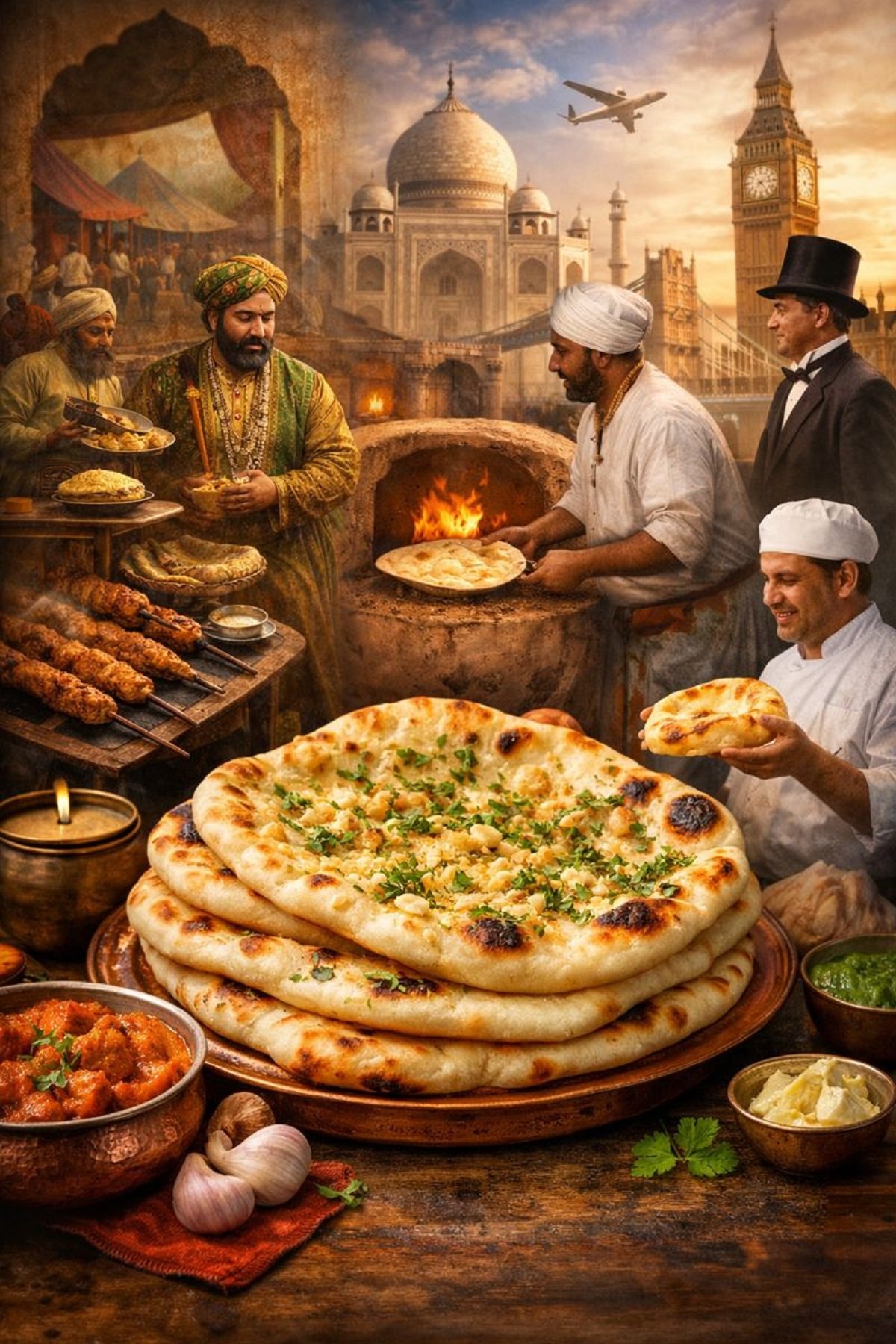
Butter Garlic Naan History-

Published

on

The Butter Garlic Naan History

Jaipur,Jan.02,2026:Butter Garlic Naan is a flavour-packed upgrade of traditional naan. Freshly baked naan is brushed generously with butter and topped with finely chopped garlic, releasing an aroma that is instantly comforting.

Its mild, slightly sweet flavour allows spicy gravies to shine, while its soft-yet-chewy texture adds depth to every meal.

Advertisement

This harmony of simplicity and indulgence is what makes Butter Garlic Naan universally appealing.

Butter Garlic Naan History and Global Recognition

The Butter Garlic Naan History entered a historic chapter when Taste Atlas ranked it number one among the world’s best breads, beating iconic European loaves.

This recognition cemented naan’s place not just as Indian comfort food, but as a global culinary treasure.

Advertisement

Where Did Naan Originate

Food historians largely agree that naan’s roots lie in ancient Persia (modern-day Iran). The word “naan” comes from the Persian term for bread.

Early Persian flatbreads were made using flour and water and cooked on heated stones. These primitive breads laid the foundation for what would later evolve into naan.

Naan’s Arrival in the Indian Subcontinent

Advertisement

Between the 13th and 16th centuries, Islamic rulers brought Persian culinary traditions to the Indian subcontinent.

Along with spices, cooking techniques, and royal etiquette came the tandoor, a clay oven that transformed naan into the fluffy, blistered bread we know today.

Naan in the Royal Courts of the Delhi Sultanate

Persian-Indian poet Amir Khusro, who lived during the reigns of Alauddin Khilji and Muhammad bin Tughlaq, documented courtly life in detail.

Advertisement

He described two types of naan

  • Naan-e-Tanuk – Thin and delicate
  • Naan-e-Tandoori – Thick, puffed, and baked in tandoor

These naans were typically served with kebabs and minced meat dishes.

 Mughal Kitchens and the Rise of Luxury Naan

During the Mughal era, naan-making became an art.

Advertisement

Special chefs called “Naan Bai” were employed exclusively to prepare this bread. Rare ingredients like yeast were used to make naan softer and richer.

Historian Neha Vermani explains that different naans were created to showcase innovation:

  • Naan-e-Warqi – Flaky, layered naan
  • Naan-e-Tangi – Small naan designed to absorb gravies

Some naans were even named after royal kitchens, such as Bakir Khani, linked to nobleman Baqir Najm Sani.

Why Naan Was Once a Royal-Only Food

The complexity of preparation, expensive ingredients, and specialised chefs made naan a luxury food for centuries.

Advertisement

For nearly 300 years, naan remained exclusive to royalty and nobility.

British Era and Naan’s Journey to the West

During British rule, naan slowly entered colonial dining culture. British travellers encountered naan in royal feasts and carried stories of it back to Europe.

Advertisement

This period marked naan’s first steps toward global awareness.

How Butter Garlic Naan Became Mainstream

As cooking techniques simplified, naan became accessible to the masses.

Advertisement

Modern naan dough typically includes flour, yogurt, yeast, and water. It is hand-shaped, slapped into a blazing-hot tandoor, and finished with butter or ghee.

This is where Butter Garlic Naan History truly transformed—becoming a staple in local restaurants and homes.

 Modern Reinventions of Butter Garlic Naan

Advertisement

In the 1990s and 2000s, chefs worldwide began experimenting.

Celebrity chef Suvir Saran recalls introducing spinach, gouda cheese, and mushrooms into naan at his New York restaurant.

He explains this made naan appealing to non-Indians while preserving its soul.

Advertisement

 Global Variations and Experiments

Today, naan is endlessly reinvented

  • Goa: Pork Vindaloo Naan
  • Hong Kong: Truffle Cheese Naan
  • UK & USA: Cheese-stuffed Garlic Naan

This global creativity has expanded the Butter Garlic Naan History beyond borders.

Why Butter Garlic Naan Represents Indian Identity

While historians debate its exact origin, naan’s emotional connection with India is undeniable.

Advertisement

Chef Saran beautifully sums it up

“Naan tells a story of diversity—where cultures coexist and celebrate differences.”

It reflects India’s ability to absorb influences and transform them into something uniquely its own.

Advertisement

A Bread That Unites Cultures

The Butter Garlic Naan History is a journey of migration, innovation, and shared heritage.

From Persian stones to Mughal tandoors, from royal darbars to global dining tables, naan has evolved while keeping its soul intact.

It reminds us that food doesn’t divide—it connects.

Advertisement

Credent TV is a dynamic and trusted media platform dedicated to delivering accurate, timely, and engaging news. With a focus on insightful journalism, Credent TV covers a wide range of topics, including current affairs, education, culture, and social issues, aiming to keep audiences informed and inspired. Led by a team of experienced professionals, Credent TV is committed to journalistic integrity, providing in-depth analysis and unbiased reporting that resonates with viewers across India. Its mission is to foster awareness, promote knowledge, and serve as a reliable source for news that matters.

Continue Reading
Advertisement
Click to comment

Leave a Reply

Your email address will not be published. Required fields are marked *

Breaking News

NLSIU Cancels 2026 Convocation Amid Opposition to CJI Surya Kant, BCI Chief

Published

on

NLSIU Cancels 2026 Convocation Amid Opposition to CJI Surya Kant, BCI Chief


Bengaluru | 27 Aug 2026

National Law School of India University (NLSIU), Bengaluru, has cancelled its 34th Annual Convocation for the graduating Class of 2026, which had been proposed for 12 September. The university cited “unavoidable circumstances” and said students would instead receive their degrees in absentia. The decision comes after hundreds of students and alumni opposed the proposed participation of Chief Justice of India Surya Kant and Bar Council of India Chairman Manan Kumar Mishra.

NLSIU Says Degrees Will Be Conferred in Absentia

NLSIU informed graduating students on 27 August that the physical convocation would not be held. The university’s Academic Administration team had earlier told students on 3 August that the annual ceremony was proposed for 12 September.

Advertisement


“Despite our collective best efforts, due to unavoidable circumstances, we are unable to hold the 34th Annual Convocation.”— National Law School of India University notice

The university said degrees would be conferred in absentia after the required approvals from its governing bodies. Graduates will be given the option of receiving their certificates by courier or collecting them from the NLSIU campus.

NLSIU has not publicly stated that the student protests or objections to the proposed guests caused the cancellation. Its official communication attributed the decision only to “unavoidable circumstances”.

Students Opposed CJI Surya Kant and BCI Chairman’s Proposed Participation

The cancellation follows an open letter signed by 165 students from NLSIU’s graduating Class of 2026, 409 current students and 128 alumni. The signatories opposed the proposed presence of CJI Surya Kant and BCI Chairman Manan Kumar Mishra at the convocation.

Advertisement


The statement was issued amid a wider dispute involving NALSAR University of Law in Hyderabad and the Bar Council of India.

“Offensive, humiliating, and a mockery of students and their struggles.”— NLSIU students and alumni, in their joint statement

The NLSIU signatories also expressed solidarity with NALSAR students and faculty and sought an unconditional apology from the BCI over its action against NALSAR’s 2026 graduating batch.

NALSAR Dispute Triggered Wider Law-School Protests

The controversy intensified after a section of NALSAR students opposed the proposed participation of CJI Surya Kant at their convocation. On 13 August, the Bar Council of India initially directed state bar councils not to enrol graduates from NALSAR’s 2026 batch while seeking information about those involved in the campaign.

Advertisement


The BCI withdrew the enrolment restriction within hours following criticism. Later that night, Chairman Manan Kumar Mishra said proceedings against the graduating batch had been closed and no further action against the students was required.

The reversal did not end the controversy. NLSIU students and alumni subsequently questioned the proposed participation of both Mishra and the Chief Justice of India at their own convocation.

What Happens Next for NLSIU’s 2026 Graduates

Although the ceremonial event has been called off, graduating students will still receive their degrees after approval by the university’s governing bodies. NLSIU is expected to communicate the procedure for choosing between campus collection and courier delivery of degree certificates.

Advertisement


As of 27 August, the university has not announced a replacement date for the 34th Annual Convocation or indicated that the ceremony will be rescheduled.

Advertisement


Continue Reading

Breaking News

PM Modi Khelo India Dialogue: Playgrounds Matter More Than PlayStations

Published

on

PM Modi Khelo India Dialogue: Playgrounds Matter More Than PlayStations


New Delhi | 27 Aug 2026

Prime Minister Narendra Modi urged schools and families to prioritise physical activity over screen time during the Khelo India Dialogue on Thursday, while outlining a wider strategy to identify young talent and prepare India for the 2036 Olympics.

PM Modi urges schools to build a sporting culture

Addressing young people nationwide through video conferencing, Modi said physical education should become an essential part of school life rather than remain a co-curricular activity. Stronger participation at the grassroots, he argued, would expand India’s talent pool and encourage families to support aspiring athletes.

Advertisement


“Sports centres are more important than screens. Playgrounds are more important than PlayStations.”— Narendra Modi, Prime Minister of India

Modi also presented sport as a way to improve health, resilience and discipline. He said participation teaches people how to compete, recover from setbacks and perform under pressure, while helping young people stay away from substance abuse.

India’s 2036 Olympics strategy targets more disciplines

The Prime Minister said India must expand its participation across Olympic disciplines to improve its medal prospects. Referring to the 2012 Olympics, he noted that India competed in only 13 sports and said the country had historically remained absent from a substantial number of medal events.

He identified surfing, sport climbing and winter sports among the areas where India could make better use of its coastline, mountains and regional strengths. Each district, he said, should assess its potential and develop athletes for sports suited to local conditions.

Advertisement


Modi called for the immediate identification and long-term preparation of athletes capable of qualifying for the 2036 Olympics. He referred to a nationwide talent hunt for children aged five to 15, with selection based on their interests and physical suitability for particular disciplines.

He said the government would support athletes from the talent-identification stage through advanced training and international competition. Specialised sports universities, modern training centres and cooperation in sports science and coaching would form part of this ecosystem, according to the Prime Minister.

Khelo India Dialogue invites ideas from young people

Modi described the Khelo India Dialogue as a policy-shaping platform rather than a ceremonial discussion. He encouraged participants to submit ideas on talent development, sports governance and emerging career opportunities.

Advertisement


The programme, organised by Mera Yuva Bharat as part of the National Sports Day 2026 celebrations, brought together young participants at two colleges in every district across states and Union Territories. Local interactions were scheduled with athletes, medal winners, public representatives and MY Bharat volunteers.

The dialogue focused on five themes: sport, Olympic aspirations, youth leadership, Viksit Bharat and Nasha Mukt Yuva. Modi said the initiative was intended to connect India’s sporting ambitions with youth-led nation-building.

Sports careers and para-athletes highlighted

The Prime Minister highlighted growing career opportunities beyond competitive sport, including sports technology, equipment design, medicine, nutrition, psychology and data analytics.

Advertisement


He also praised Indian para-athletes, including Sheetal Devi, Avani Lekhara, Sumit Antil and Nitesh Kumar, saying their achievements had transformed public attitudes towards disability and inspired families across the country.

Modi offered advance greetings for National Sports Day on 29 August and paid tribute to hockey legend Major Dhyan Chand. He said Khelo India had developed into a major platform for nurturing talent and helping young athletes pursue their sporting ambitions.

Advertisement


Continue Reading

Breaking News

HAF Issues Security Alert After Mamdani Opposes Mohan Bhagwat’s New York Event

Published

on

HAF Issues Security Alert After Mamdani Opposes Mohan Bhagwat’s New York Event


New York | 27 Aug 2026

The Hindu American Foundation has issued a security advisory ahead of RSS chief Mohan Bhagwat’s 29 August appearance in New York, urging attendees to remain vigilant and calling on Mayor Zohran Mamdani to protect their safety and civil rights after he publicly opposed the event.

HAF Security Alert Urges Vigilance and Restraint

The Hindu American Foundation said it issued the community advisory before the Universal Oneness Celebration at the Infosys Theater at Madison Square Garden. Bhagwat is scheduled to address the gathering on Saturday.

“Stay vigilant, remain situationally aware, and keep interactions civil.”— Hindu American Foundation

HAF advised attendees to respect the rights of others to assemble, protest and express their views. It asked people to report suspicious activity to security personnel or law enforcement, leave the area if they felt threatened and avoid confrontations with anyone making provocative or threatening statements.

Advertisement


The organisation alleged that activists targeting Hindu Americans had attempted to disrupt or cancel the celebration. Its public advisory did not identify a specific imminent threat.

HAF also urged Mamdani to uphold his responsibility to protect all New Yorkers, including those attending the programme, and guarantee their safety and civil rights.

Mamdani Opposes Mohan Bhagwat’s New York Event

Mamdani said he did not support the gathering but acknowledged that New York City might not have the authority to prevent a private event from proceeding.

Advertisement


“I don’t support the rally, but I don’t know if the city has any jurisdiction on cancelling a private event.”— Zohran Mamdani, Mayor of New York City

The mayor said his understanding of India was rooted in a pluralistic and secular republic where every person belonged. He expressed concern about what he described as the rise of an exclusionary political vision.

No cancellation of the event had been announced as of 27 August, and the programme remained scheduled for 29 August.

Protests Planned Outside Madison Square Garden

Hindus for Human Rights and other organisations opposing Bhagwat’s participation have announced demonstrations outside Madison Square Garden on the day of the event. The Indian American Muslim Council and the Interfaith Center of New York are among the groups that have criticised the planned appearance.

Advertisement


American Hindus for Engagement and Dialogue, the event’s organiser, describes the Universal Oneness Celebration as a gathering promoting shared heritage, interfaith engagement and unity among Hindu Americans and other communities.

The RSS has said the programme will involve a diverse, multicultural and multi-faith audience. The organisation rejects allegations that it promotes intolerance and describes itself as a Hindu-centred cultural and civilisational movement.

US Panel Adds Pressure During Bhagwat’s Visit

The controversy has intensified during Bhagwat’s US visit after the US Commission on International Religious Freedom recommended targeted sanctions against RSS members and Indian officials it accused of involvement in religious-freedom violations. The commission also called for Bhagwat’s US visa to be revoked.

Advertisement


USCIRF is a bipartisan government body, but its policy recommendations are not binding. The United States government had not announced sanctions in response to the latest recommendation.

India’s Ministry of External Affairs has rejected USCIRF’s assertions, describing the commission as biased and lacking credibility. The Indian government denies discriminating against religious minorities and maintains that its welfare policies benefit citizens across communities.

Advertisement


Continue Reading

Breaking News

Reports Claim Pakistan Deployed Bayraktar TB2 Drones Near LoC

Published

on

Reports Claim Pakistan Deployed Bayraktar TB2 Drones Near LoC

India-Pakistan Line of Control | 26 Aug 2026

Indian media reports citing unnamed security sources claim Pakistan has deployed Turkish-made Bayraktar TB2 armed drones near the Line of Control for surveillance of Indian military positions. However, the reported deployment has not been publicly confirmed by India’s Ministry of Defence, the Indian Army, Pakistan’s military or drone manufacturer Baykar.

Reports allege Bayraktar TB2 activity near LoC

The reports claim Indian security agencies detected Bayraktar TB2 drones operating close to the Line of Control and assessed that the aircraft could be collecting information about terrain, troop movements and surveillance arrangements.

They also cite unnamed sources as saying ground-control infrastructure and mobile operating units may be positioned near Muzaffarabad and Kotli in Pakistan-administered Kashmir, which India calls Pakistan-occupied Jammu and Kashmir.

No publicly available photographs, satellite images, radar records, serial numbers or official statements establishing the location and timing of the reported TB2 flights accompanied the claim. Credent TV could not independently verify that the drones had been moved to forward areas or flown near the LoC.

Pakistan’s possession of TB2 drones is established

Pakistan’s possession of the Bayraktar TB2 is better documented than the latest deployment claim. Pakistan Air Force imagery from an operational air-defence exercise in September 2022 showed at least two TB2 aircraft, according to defence intelligence publication Janes.

Earlier satellite imagery had also shown a TB2 and associated ground-control equipment at Pakistan Air Force Base Murid in Chakwal district. The facility is named Murid, not Muridke, which is a separate city in Punjab province.

The total number of TB2 drones currently operated by Pakistan has not been officially disclosed. There is also no public confirmation that any flight reported near the LoC originated from PAF Base Murid or another identified facility.

What the Bayraktar TB2 can do

Baykar describes the TB2 as a medium-altitude, long-endurance unmanned combat aircraft designed for intelligence, surveillance, reconnaissance and precision-strike missions.

The manufacturer lists a 12-metre wingspan, a maximum take-off weight of 700 kilograms, a 150-kilogram payload capacity, an operational altitude of 16,000 feet and endurance exceeding 18 hours. The aircraft can carry electro-optical and infrared sensors, laser-designation equipment, surveillance radar and guided munitions.

Its endurance and real-time imagery capability could support sustained monitoring of military activity. Its ability to carry weapons means an armed configuration can conduct strikes, but the sighting of a TB2 would not by itself establish that the aircraft was carrying munitions.

The expression “Russia killer”, used in some coverage, is not an official military or manufacturer designation for the TB2.

India has previously raised cross-border drone concerns

During an official briefing on May 9, 2025, Colonel Sofiya Qureshi said Pakistan had attempted drone incursions at 36 locations between Leh and Sir Creek using approximately 300 to 400 aircraft. She said the possible objectives included testing Indian air-defence systems and gathering intelligence.

Initial examination of debris from that episode indicated the use of Turkish-made Asisguard Songar drones, according to the briefing. The Songar and Bayraktar TB2 are different aircraft, so that official finding does not confirm the latest TB2 deployment claim.

Separate suspected Pakistan-origin drone sightings have continued along the LoC and International Border. Security forces have responded with counter-drone measures and searches to determine whether weapons or narcotics were dropped.

Verification remains critical

If independently confirmed, forward deployment of long-endurance armed drones would expand Pakistan’s ability to monitor activity near sensitive LoC sectors and reduce the time required to conduct surveillance missions.

However, definitive conclusions require official confirmation or verifiable evidence identifying the aircraft, flight path and operating location. Claims about the drones carrying weapons, conducting hostile surveillance or preparing for attacks should not be presented as established facts without such evidence.

Indian authorities had not publicly announced any new military response specifically linked to the reported TB2 deployment as of August 26.

Continue Reading

Breaking News

Zohran Mamdani Opposes Mohan Bhagwat’s New York Event, Sparking Political Row

Published

on

Zohran Mamdani Opposes Mohan Bhagwat’s New York Event, Sparking Political Row


New York | 26 Aug 2026

New York City Mayor Zohran Mamdani has opposed an August 29 event featuring Rashtriya Swayamsevak Sangh chief Mohan Bhagwat at Madison Square Garden, triggering divided reactions from Indian political leaders and civil rights organisations.

Mamdani opposes Mohan Bhagwat’s New York event

Mamdani said he did not support the private gathering but acknowledged that the New York City administration might not have the authority to prevent it from taking place.

“I don’t support the rally, but I don’t know if the city has any jurisdiction on cancelling a private event.”— Zohran Mamdani, Mayor of New York City

Mamdani, New York City’s first Muslim and Indian-American mayor, said his family had taught him to view India as a pluralistic and secular republic in which every citizen belonged equally. He described movements based on what he called an exclusionary vision as troubling and said they conflicted with New York’s commitment to diversity.

Advertisement


His comments did not amount to an order cancelling the programme, and no cancellation had been announced as of August 26.

Universal Oneness Celebration scheduled for August 29

Bhagwat is scheduled to deliver the keynote address at the Universal Oneness Celebration on August 29. The programme is being organised by the AHEAD Forum, formally known as American Hindus for Engagement and Dialogue.

Organisers describe the gathering as an initiative promoting shared heritage, interfaith harmony and the principle of Vasudhaiva Kutumbakam, meaning “the world is one family”. The AHEAD Forum said more than 200 Hindu American organisations were supporting the programme.

Advertisement


The event coincides with Raksha Bandhan and is part of the RSS’s centenary-year international outreach. Bhagwat’s overseas itinerary also includes visits to Canada and the United Kingdom.

Indian political leaders divided over Mamdani’s position

Mamdani’s opposition prompted contrasting responses from Indian political parties. BJP leaders Syed Zafar Islam and Bhola Singh criticised his position and defended the RSS as an organisation involved in social service and nation-building.

Shiv Sena spokesperson Shaina NC accused Mamdani of appeasement politics and questioned what she described as double standards towards the RSS and organisations associated with its community work.

Advertisement


Shiv Sena (UBT) leader Anand Dubey also called the opposition unwarranted. Although acknowledging his party’s political differences with the RSS, Dubey argued that those disagreements should not result in opposition to an Indian leader visiting another country.

Congress MP Imran Masood questioned the purpose of the programme and the message its organisers intended to convey internationally. Trinamool Congress MP Saugata Roy, meanwhile, said opposition to the event was understandable in a religiously diverse city such as New York.

Interfaith and civil rights groups seek cancellation

Several interfaith, civil rights and community organisations have urged Madison Square Garden to cancel Bhagwat’s appearance. Groups involved in the opposition include Hindus for Human Rights, the Indian American Muslim Council and the Interfaith Center of New York.

Advertisement


The organisations have raised objections to the RSS’s ideology and record. The RSS rejects allegations of intolerance and describes itself as a Hindu-centred cultural and civilisational movement focused on social organisation and national development.

The AHEAD Forum has maintained that the programme is intended to promote mutual respect, unity and dialogue across communities. With Mamdani questioning the city’s jurisdiction over a privately organised indoor event, any decision affecting the booking would rest with the venue or organisers unless a valid legal or public-safety ground emerged.

Advertisement


Continue Reading

Breaking News

Amit Shah Sets Goal to Make India Free of Illegal Immigration

Published

on

Amit Shah Sets Goal to Make India Free of Illegal Immigration


New Delhi | 25 Aug 2026

Union Home Minister Amit Shah said the government aims to make India free of illegal immigration in the shortest possible time, describing unauthorised entrants as a threat to national security, the economy and demographic stability.

Four-pronged plan targets illegal immigration

Addressing the valedictory session of the Intelligence Bureau’s two-day National Security Strategies Conference in New Delhi, Shah said the Home Ministry had visited every state sharing a land border during the past eight months.

He said the ministry had shared a document setting out a four-pronged border security approach with those states. Each state should appoint a nodal officer of at least Senior Inspector General or Additional Director General rank to coordinate the campaign, he added.

Advertisement


“Our aim is to make the country infiltrator-free in a very short time.”— Amit Shah, Union Home Minister

Shah said India was not a “dharamshala” for people entering or staying illegally. Foreign nationals wishing to live in the country must use legal channels and obtain the required permission from the ministries of External Affairs and Home Affairs, he said.

The conference was attended physically and virtually by senior police officers, directors general of police from the states and representatives of central security agencies.

Shah calls for long-term internal security strategy

Shah urged security agencies to study trends that could shape India’s internal security over the next 15 to 20 years and prepare preventive strategies before emerging problems become major threats.

Advertisement


He said security planning must account for global instability, uncertainty over energy and resources, supply-chain disruptions, growing radicalisation, cyber warfare and misinformation campaigns. Stronger coordination between the Centre, states and security agencies would be essential, he added.

Shah also asked the Intelligence Bureau to convene a meeting with districts along India’s maritime borders before the next conference and prepare a time-bound security roadmap.

Criminal laws and fugitive tracking

The Home Minister said the three new criminal laws would be fully implemented within the next year. He claimed the reforms would help conclude criminal cases through the Supreme Court within three years and increase the conviction rate by 25 per cent.

Advertisement


Shah said the government had strengthened mechanisms for bringing fugitives back to India, with around 274 people returned from abroad between 2019 and 2026. He asked state police forces to establish dedicated systems for pursuing fugitives residing overseas.

He also highlighted provisions for trials in absentia under the new legal framework and asked police chiefs to create dedicated units to follow up on such cases.

Technology and narcotics enforcement

Shah said an integrated data bank connecting CCTNS, ICJS, NATGRID and NAFIS had been created. He encouraged officers to use artificial intelligence for data analysis, identifying criminal methods and generating actionable intelligence.

Advertisement


On narcotics, he directed state police forces to implement the Narcotics Control Vision Document 2026–2029 and follow the “Detect, Disrupt and Destroy” approach. Dedicated teams should be formed in every state to carry out the programme, he said.

Shah said early identification of security challenges, supported by Centre-state cooperation, was necessary to build what he described as a secure, infiltration-free and drug-free India.

Advertisement


Continue Reading

Breaking News

Rasuwa Flood Leaves 28 Security Personnel Unreachable as Nepal Mounts Rescue

Published

on

Rasuwa Flood Leaves 28 Security Personnel Unreachable as Nepal Mounts Rescue


Rasuwa | 26 Aug 2026

A sudden Rasuwa flood left 28 security personnel out of contact on Wednesday after the Bhote Koshi River surged through Timure and Syabrubesi, damaging settlements, police posts and power infrastructure and triggering downstream warnings across five Nepalese districts.

Search begins for 28 security personnel

The personnel include 19 members of Nepal Police and nine from the Armed Police Force, according to information presented at an emergency meeting of Nepal’s National Disaster Risk Reduction and Management Council.

Thirteen of the 22 officers assigned to the Rasuwagadhi Police Post remained unreachable, while six of nine officers stationed in Syabrubesi were also out of contact. Nine Armed Police Force personnel deployed at the Timure Border Outpost had not established contact.

Advertisement


The flood struck at about 9 am after water entered the Bhote Koshi from the Tibetan side of the Nepal–China border. Officials were still assessing the overall casualty toll and the full scale of the destruction.

Rasuwa flood alert extends downstream

Authorities placed communities along the Bhote Koshi and Trishuli rivers on high alert in Rasuwa, Nuwakot, Dhading, Gorkha and Chitwan. Residents near riverbanks, markets and other vulnerable areas were instructed to move to safer ground.

The government advised people to avoid the Prithvi Highway, the Galchhi–Nuwakot–Rasuwa–Syabrubesi road and the Mugling–Narayangadh corridor while emergency operations continued.

Advertisement


Floodwater entered Nuwakot District Prison, but its inmates were transferred to a safe location. The water level there later began receding, according to the prison administration.

Homes and power infrastructure damaged

Preliminary assessments indicated that approximately 60 houses near Trishuli Bazaar in Nuwakot were swept away. Two concrete bridges across the Trishuli River were also destroyed. No deaths had been reported in Nuwakot at the time of the district administration’s initial assessment.

The Nepal Electricity Authority reported damage to six major power facilities: Rasuwagadhi, Chilime, Trishuli 3A, the Trishuli 3B Hub 220-kilovolt substation, Trishuli Hydropower Station and Devighat Hydropower Station. Electricity distribution infrastructure was also affected.

Advertisement


Markets, houses, hotels and vehicles were reported damaged in Timure and Syabrubesi. Three Nepal Police offices—the Timure Area Police Office, Syabrubesi Police Post and Rasuwagadhi Police Post—also sustained damage.

Flood cause and rescue response

The Department of Hydrology and Meteorology said rainfall was not considered the cause of the flood. Senior meteorologist Meen Kumar Aryal said rainfall in parts of Rasuwa had not exceeded seven millimetres during the preceding 24 hours.

Officials were investigating whether a glacial lake outburst or another upstream event caused the sudden surge. No definitive cause had been established.

Advertisement


Prime Minister Balendra Shah ordered intensified search, rescue and relief operations. The Nepali Army, Nepal Police, Armed Police Force and district authorities mobilised personnel, while two military helicopters and medical teams were deployed to the affected region.

The government also convened emergency disaster-management and Cabinet meetings to coordinate evacuations, relief supplies and the search for those who remained unreachable.

Advertisement


Continue Reading

Bollywood

Kuku Kohli Dies at 77; ‘Phool Aur Kaante’ Director Launched Ajay Devgn

Published

on

Kuku Kohli Dies at 77; ‘Phool Aur Kaante’ Director Launched Ajay Devgn


Mumbai | 26 Aug 2026

Veteran Hindi filmmaker Kuku Kohli has died at 77 in Mumbai after suffering a massive heart attack. Kohli, best known for directing the 1991 film Phool Aur Kaante, which launched Ajay Devgn as a leading actor, died on Tuesday, 25 August, at Kokilaben Dhirubhai Ambani Hospital.

Kuku Kohli Dies at 77 After Massive Heart Attack

Filmmaker Ashoke Pandit, a friend of Kohli, confirmed the death. He told PTI that Kohli had felt uncomfortable and was admitted to Kokilaben Dhirubhai Ambani Hospital on Monday.

“He was feeling uncomfortable and was admitted to Kokilaben Dhirubhai Ambani Hospital on Monday. He passed away due to a massive heart attack around 4.30 pm.”— Ashoke Pandit, filmmaker and Kuku Kohli’s friend

Separate accounts from Kohli’s family and representatives said doctors had treated a cardiac blockage and placed a stent before his condition deteriorated on Tuesday evening.

Advertisement


Kohli is survived by veteran actor Aruna Irani and his two daughters from an earlier marriage, Pooja Kohli and filmmaker Karishma Kohli.

‘Phool Aur Kaante’ Director Gave Ajay Devgn His Film Debut

Kohli remains most closely associated with Phool Aur Kaante, his 1991 directorial debut. The action-romance introduced Ajay Devgn as a leading actor and also featured Madhoo, Aruna Irani, Jagdeep and Amrish Puri.

Devgn’s entrance in the film, balancing with one foot on each of two moving motorcycles, became one of the most recognisable debut sequences in mainstream Hindi cinema.

Advertisement


Kohli later worked with Devgn again in the 1994 action film Suhaag, which also starred Akshay Kumar, Karisma Kapoor and Nagma, and in Haqeeqat in 1995 alongside Tabu.

Kuku Kohli’s Career Included ‘Suhaag’, ‘Anari No. 1’ and ‘Zulmi’

Before becoming an independent director, Kohli worked in filmmaking under established directors including Raj Kapoor and was associated with productions such as Betaab and Arjun.

His directing credits included Kohraam, Suhaag, Haqeeqat, Anari No. 1, Zulmi and Yeh Dil Aashiqanaa. His final feature-film directorial release was Woh Tera Naam Tha in 2004.

Advertisement


Film Industry Pays Tribute as Last Rites Set for Wednesday

Indian Motion Picture Producers’ Association president Abhay Sinha also confirmed Kohli’s death and expressed condolences. Ashoke Pandit separately shared a tribute remembering the filmmaker.

Kohli’s last rites are scheduled to be held on Wednesday, 26 August, at Mumbai’s Oshiwara Crematorium. Reports said the cremation was planned for 11 am, following a final viewing earlier in the morning.

Advertisement


Continue Reading

Breaking News

Anil Chauhan Says Politics and War Are Inseparable in Operation Sindoor Address

Published

on

Anil Chauhan Says Politics and War Are Inseparable in Operation Sindoor Address


New Delhi | 25 Aug 2026

Former Chief of Defence Staff General Anil Chauhan said politics and warfare were inseparable, arguing that military force must serve clearly defined political objectives. He made the remarks during a discussion on Operation Sindoor and its aftermath at the Vivekananda International Foundation in New Delhi on Tuesday.

  • Political objectives shape military options
  • Defence preparedness determines available choices
  • Operation Sindoor remains strategically relevant
  • Chauhan calls for changing military strategies

Political objectives shape military options

Invoking Prussian military theorist Carl von Clausewitz, Chauhan said a country’s political interests remained paramount and the armed forces were one of several instruments available to protect them.

“Politics and war are inseparable. Clausewitz said that war is a continuation of politics by other means.”— General Anil Chauhan, former Chief of Defence Staff

Chauhan said that when a democratic government decided to use force, the military had two principal responsibilities: offering options capable of meeting the government’s objectives and giving the political leadership confidence that those options could be executed successfully.

Advertisement


He stressed that each military choice involved a different level of operational risk and had to be evaluated against the political purpose it was intended to achieve.

“Each option has a certain kind of risk involved in it. So, it’s an interplay between risk and attainment of political objectives.”— General Anil Chauhan, former Chief of Defence Staff

Defence preparedness determines available choices

According to Chauhan, the number and quality of options available during a crisis depend on investments made during peacetime. Defence capabilities, military training, war games and contingency planning must be developed well before the government considers deploying force, he said.

Military leadership also influences the choices available to the government through the quality of training and operational scenarios it prepares. No armed force could remain completely prepared for every contingency at all times, he added, making continuous assessment and adaptation essential.

Advertisement


Operation Sindoor remains strategically relevant

Discussing the Operation Sindoor aftermath, Chauhan said the main phase of active operations had concluded but the campaign remained relevant to strategic communities in India and abroad.

“In some ways, it is ongoing. The major part of active operations has concluded, but this remains a subject of interest for the strategic community.”— General Anil Chauhan, former Chief of Defence Staff

He said the operation should be assessed alongside the deficiencies identified during it, measures taken to address those gaps, the changing character of warfare and wider global uncertainty.

India launched Operation Sindoor on 7 May 2025 following the 22 April terrorist attack in Pahalgam, which killed 25 Indian citizens and one Nepali national. The Indian government said its forces targeted nine terrorist facilities in Pakistan and Pakistan-occupied Jammu and Kashmir.

Advertisement


India and Pakistan subsequently exchanged military strikes before agreeing on 10 May 2025 to stop firing and military action on land, in the air and at sea.

Chauhan calls for changing military strategies

Chauhan said military planners could not repeatedly rely on the same response because predictability reduced the prospects of success. He cited India’s different approaches following the Uri, Pulwama and Pahalgam attacks.

The response after Uri involved land-based surgical strikes, while the Balakot operation following the Pulwama attack used air power. Operation Sindoor employed another approach, including the use of lower airspace, which Chauhan said was intended to preserve surprise and control the threshold of conflict.

Advertisement


Chauhan served as India’s second Chief of Defence Staff until 30 May 2026. General NS Raja Subramani assumed charge as the country’s third CDS on 31 May 2026.

Advertisement


Continue Reading

Breaking News

Trump Considers Renaming Lake Ontario ‘Lake America’ as Canada Trade Dispute Escalates

Published

on

Trump Considers Renaming Lake Ontario ‘Lake America’ as Canada Trade Dispute Escalates


Washington | 25 Aug 2026

US President Donald Trump said on Tuesday that his administration was considering renaming Lake Ontario “Lake America”, linking the proposal to the escalating trade dispute between the United States and Canada. No formal name-change measure was announced.

Table of Contents

Advertisement


  • Trump’s Lake Ontario Proposal Remains Informal
  • Canada Declines to Engage With Renaming Remark
  • Tariffs Deepen US-Canada Trade Dispute
  • Lake Ontario Is a Shared Boundary Water

Trump’s Lake Ontario Proposal Remains Informal

Trump raised the possible change in a post on Truth Social, saying the United States expected to conduct substantially less business with Ontario. He later shared an altered map showing the existing name crossed out and “Lake America” displayed in its place.

“The United States is giving serious consideration to changing the name of Lake Ontario to Lake America.”— Donald Trump, President of the United States

The post did not specify whether the administration would issue an executive order or pursue another formal process. Trump previously directed US federal agencies to use “Gulf of America” for the Gulf of Mexico through an executive order signed in January 2025.

Canada Declines to Engage With Renaming Remark

Dominic LeBlanc, Canada’s minister responsible for US trade, said the federal government would not respond to daily social-media statements from Trump or members of his administration.

The Canadian government did not indicate that it would recognise any alternative name for the lake. Trump’s proposal would not by itself determine how Canadian authorities, international organisations or institutions outside the United States identify the waterway.

Advertisement


Tariffs Deepen US-Canada Trade Dispute

The remarks came after bilateral trade negotiations broke down and Washington imposed tariffs of 50 per cent on Canadian goods valued at C$27.6 billion, effective from 22 August.

Canada subsequently announced matching counter-tariffs on C$27.6 billion of US products from 8 September. The measures cover sectors including steel and aluminium, dairy products, appliances, agricultural equipment, pulp and paper, plastics and electronics. Existing Canadian counter-tariffs on US vehicles will remain in force.

Trump has also threatened tariffs of 50 per cent on Canadian vehicles, automotive components and steel. Canadian Prime Minister Mark Carney has accused Washington of seeking concessions that would damage Canada’s automotive, steel and aluminium industries.

Advertisement


Lake Ontario Is a Shared Boundary Water

Lake Ontario is one of North America’s five Great Lakes. It lies between the Canadian province of Ontario and the US state of New York and forms part of the international boundary between the two countries.

Canada and the United States cooperate on shared waters through arrangements including the 1909 Boundary Waters Treaty and the International Joint Commission. Trump’s post did not explain how the proposed name would apply to the lake’s binational status or existing cross-border institutions.

Trump Lake Ontario name change, Lake America proposal, US Canada trade dispute, Trump Canada tariffs, Canada retaliatory tariffs, Lake Ontario latest news, US Canada relations, Donald Trump Canada policy

Advertisement


#DonaldTrump #LakeOntario #LakeAmerica #CanadaUSTrade #WorldNews

Advertisement


Continue Reading

Trending Post